
Education Operations Software | Universities, Colleges and Schools
Manage operations across your educational estate with software built specifically for education by the Director of Sport at the University of Reading. OpsPal helps universities, colleges, schools, and multi-academy trusts (MATs) manage facilities, ensure safeguarding compliance, track staff qualifications, maintain premises’ safety, and demonstrate governance to Ofsted, governors, and trustees—all while supporting educational excellence through efficient operations. See how Stirling University are using OpsPal







































Built for education, trusted by leading institutions
OpsPal was created by the Director of Sport at the University of Reading because existing systems couldn’t manage the complexity of educational operations — sports facilities, academic buildings, residential accommodation, catering operations, estates maintenance and student services across campus.
Today, leading UK universities, colleges, schools and multi-academy trusts use OpsPal to manage operations that support educational delivery. From Russell Group universities managing extensive estates to primary schools ensuring playground safety, the system adapts to educational institutions of all sizes and types.
Educational Operations Software in Universities and higher education
Manage complex multi-site estates, including sports centres, academic buildings, student accommodation, catering facilities, laboratories, libraries and specialist facilities. Track facilities maintenance, compliance obligations, staff qualifications and health and safety across diverse operational environments. Support student experience through well-maintained facilities whilst demonstrating governance to university leadership and regulatory bodies.
Colleges and further education
Coordinate operations across teaching facilities, workshops, sports areas, student services and estates. Ensure safeguarding compliance, track staff and contractor qualifications, manage premises safety and demonstrate governance to college governors and education inspectors. Balance operational efficiency with educational quality in resource-constrained environments.
Schools and multi-academy trusts
Maintain safe premises for pupils, track safeguarding requirements, manage site staff and contractor coordination, ensure compliance with DfE guidance and demonstrate governance to school governors, trustees and Ofsted. MATs gain visibility across all schools in the trust, standardising best practice whilst accommodating site-specific requirements.
Safeguarding and compliance for educational environments
Educational settings carry unique safeguarding responsibilities and regulatory compliance requirements. OpsPal provides the systems and audit trails demonstrating systematic safeguarding and compliance management.
Single Central Record (SCR) support
Track essential staff information contributing to your Single Central Record — DBS checks, identity verification, qualifications, prohibition from teaching checks, overseas checks and right to work documentation. Automated reminders ensure DBS renewals don’t lapse. Link safeguarding training to staff records, proving everyone working with children or vulnerable students has current safeguarding knowledge.
Site safety and premises compliance
Educational premises require extensive compliance tracking — fire safety inspections, emergency lighting tests, legionella monitoring, gas safety checks, electrical testing, playground inspections, PE equipment examinations, asbestos management and building condition surveys. Schedule all inspections according to DfE and HSE requirements. Track completion with audit trails showing systematic premises management to governors and inspectors.
Contractor management and vetting
Contractors working on educational premises require appropriate checks and supervision. Track contractor DBS status, induction completion, site-specific briefings and supervision requirements. Ensure contractors understand safeguarding responsibilities and site safety rules before accessing premises where children or students are present.
Risk assessments for educational activities
Manage risk assessments for educational visits, sports activities, science practical work, DT workshops, drama productions, outdoor education and routine premises activities. Link assessments to activity delivery, ensuring staff refer to risk assessments when planning and supervising educational experiences. Update assessments when circumstances change and communicate revisions to relevant staff instantly.
Ofsted and inspection readiness
Demonstrate to Ofsted or education inspectors that you manage safeguarding, health and safety and premises systematically. Generate reports showing policy distribution, staff training completion, risk assessment coverage, incident investigation and premises compliance. Prove effective governance rather than scrambling to compile evidence when inspection is announced.

Support teaching staff and site teams efficiently
Educational institutions employ diverse workforces — teaching staff, support staff, site teams, catering staff, sports coaches, technicians and cleaners. Each group has different operational needs, training requirements and access to information.
Empowering site and facilities teams
Caretakers, site managers and facilities staff manage complex premises with limited resources. Digital checklists for opening/closing procedures, daily safety checks, maintenance routines and cleaning schedules ensure consistency regardless of which team member is on duty. Mobile access means site staff complete tasks and report issues in real-time without returning to offices for paperwork.
Problem reporting captures maintenance issues, safety concerns and defects immediately. Site teams photograph problems, add location information and assign urgency. This ensures nothing is forgotten and creates accountability for resolution. Governors and senior leadership see maintenance backlogs and problem resolution rates across the estate.
Supporting teaching staff with operational information
Teachers focus on education, not operational management. OpsPal ensures teaching staff access the operational information they need without administrative burden — risk assessments for educational visits, equipment usage procedures, incident reporting processes and emergency procedures are available on any device when needed.
When teaching staff identify problems (broken equipment, safety hazards, maintenance issues), they report concerns in seconds. Site teams receive notifications and take action, closing the loop so teaching staff know their concerns are addressed.
Standardising procedures and best practice
Educational institutions benefit from proven procedures developed through experience. Digital procedure management shares best practice across departments or schools in a MAT. When one school develops excellent practice for managing educational visits, playground supervision or parent communication, roll out improvements across the trust instantly.
Heads of department ensure subject-specific procedures are current and accessible — science practical safety, DT workshop rules, PE equipment protocols, art materials handling. Update procedures in response to incidents, regulatory changes or improvement initiatives. Track which staff have read updated procedures, ensuring changes are communicated effectively.
Governance and accountability for educational leadership
Governors, trustees and senior leadership carry accountability for operational management supporting educational delivery. OpsPal provides the visibility and evidence educational governance requires.
Governor and trustee oversight
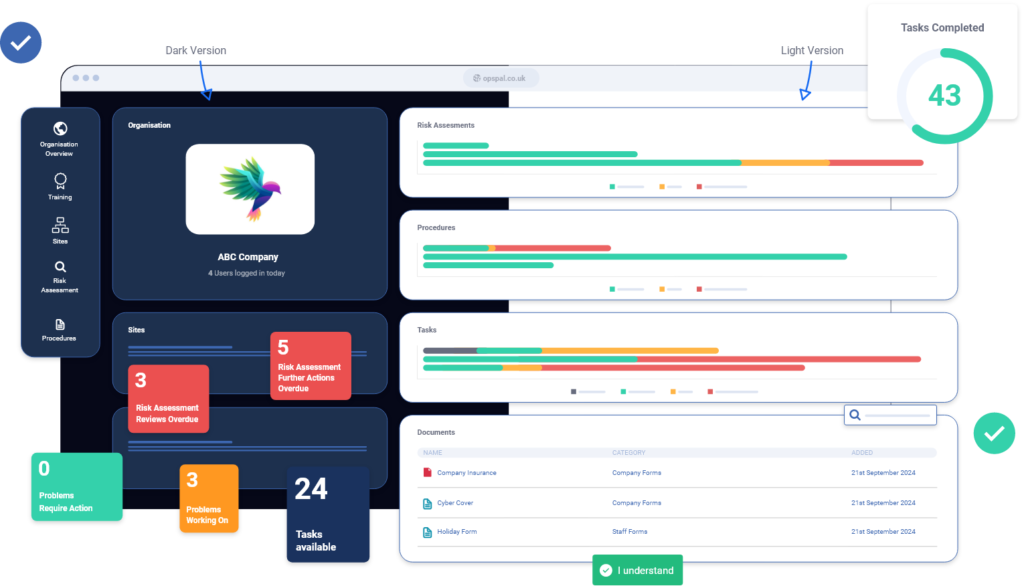
Governors and trustees need assurance that premises are safe, safeguarding is robust, compliance is maintained and operational resources are used efficiently. Dashboards show health and safety performance, premises compliance status, safeguarding training completion and maintenance backlogs across the estate. Generate reports for governing body meetings without lengthy preparation time.
Audit trails demonstrate systematic operational management rather than reactive responses to problems. When governors ask about specific incidents, compliance areas or operational decisions, produce complete evidence immediately. This transparency supports governance accountability and informed decision-making.
Multi-academy trust (MAT) oversight
MAT central teams need visibility across all schools in the trust. Compare operational performance, identify schools needing support, and share best practice across the MAT. Standardise policies, procedures and training whilst accommodating site-specific requirements. Track compliance obligations across all schools, ensuring no location has gaps that create trust-wide risk.
Location-based data shows which schools operate efficiently and which consume disproportionate resources or generate persistent problems. Use this intelligence for strategic decisions about facilities investment, staffing allocation or operational improvement initiatives.
Self-evaluation and improvement planning
Educational institutions continuously self-evaluate and improve. Track action plans from self-evaluation, inspection recommendations or strategic initiatives. Assign improvement actions to owners, monitor progress and evidence completion. Link operational improvements to educational outcomes and student experience enhancements.
Professional development tracking supports staff capability building. Record training attendance, qualifications gained and competency development. Demonstrate staff development investment to governors, inspectors and staff themselves. Link training to improved operational performance and incident reduction.
Efficient operations supporting educational excellence
Well-managed operations create the environment where education flourishes. When premises are safe, maintained and compliant, when staff are qualified and supported, and when problems are resolved promptly, teaching and learning benefit. OpsPal enables efficient operational management so leadership focus remains on educational quality, student outcomes and institutional improvement.
Frequently Asked Questions
What is education operations management software?
Education operations management software is a digital platform that helps schools, colleges, universities and educational establishments manage facilities, compliance, health and safety, and operational tasks through connected systems accessible on any device. Instead of relying on paper-based procedures stored in site offices, spreadsheets tracking maintenance schedules, and hoping staff remember compliance deadlines, the software centralises operational documentation, task management, risk assessments, training records and incident tracking—providing real-time visibility of site operations whilst ensuring regulatory requirements and Ofsted expectations are met consistently.
The platform addresses the operational challenges educational establishments face beyond teaching and learning. Site management requires premises checks, security procedures, fire safety systems and maintenance schedules tracked systematically. Health and safety compliance demands risk assessments for activities from science experiments to educational visits, staff acknowledgement tracking, and incident management with complete audit trails. Facilities teams coordinate cleaning schedules, equipment inspections and contractor management. Compliance obligations include statutory inspections, asbestos registers, water safety monitoring and emergency procedure reviews.
Different educational settings have different operational priorities. Primary schools balance safeguarding requirements with limited administrative capacity. Secondary schools coordinate complex timetables, multiple departments and extensive facilities across large sites. Further education colleges manage vocational workshops with specialist equipment and safety requirements. Universities operate multiple buildings, residential facilities and public-facing venues. The software adapts to these different operational contexts whilst providing the systematic structure that demonstrates safe, compliant site management to Ofsted, local authorities and governing bodies.
Education operations software replaces fragmented manual systems where site teams work separately from teaching staff, compliance activities are coordinated through email chains, and operational knowledge exists in individual caretakers’ or premises managers’ memories. Digital systems create visibility across operational and educational functions, ensuring facilities support learning effectively whilst meeting the regulatory frameworks educational establishments operate within.
How does education software help schools meet Ofsted requirements?
Education software helps schools meet Ofsted requirements by creating systematic operational management with complete audit trails that demonstrate health and safety, safeguarding and site management are planned, monitored and reviewed consistently. Ofsted inspectors evaluate whether schools have effective systems for maintaining safe premises, managing risks and ensuring staff understand their responsibilities. Digital platforms provide the evidence inspectors expect—risk assessments current and acknowledged by staff, compliance tasks completed consistently over time, incidents investigated with corrective actions tracked, and training records showing staff competency for operational roles.
Risk assessments for activities, trips, facilities and safeguarding concerns are stored digitally with staff acknowledgement tracking. When assessments are updated, staff receive in-app bell notifications and must acknowledge changes before the system marks them compliant. Version control with visual comparison shows exactly what changed between revisions, ensuring staff understand updated safety requirements. This creates audit trails proving health and safety information reached the people who need it—exactly what Ofsted guidance requires schools to demonstrate.
Compliance activities like fire alarm tests, legionella monitoring, equipment inspections, playground checks and security procedures are scheduled as recurring tasks with dashboard visibility. Colour-coded indicators show which activities are current (green), due within 30 days (amber) or overdue (red). Site managers see exactly which statutory inspections need attention, preventing compliance gaps that Ofsted inspections reveal. When site staff leave, the system automatically transfers their tasks to replacements, ensuring premises safety continues regardless of staff changes.
When Ofsted inspectors visit, log reports filtered by date range generate comprehensive evidence showing operational management is systematic rather than reactive. Task completion records demonstrate fire safety checks, water testing and equipment inspections occurred consistently. Staff acknowledgement reports prove safeguarding policies and risk assessments reached everyone working in the school. Training matrix reports show site staff, teaching assistants and technicians hold required qualifications. This systematic documentation demonstrates that health and safety management meets the “effective leadership and management” criteria Ofsted judges schools against.
What are the biggest operational challenges in education settings?
Education settings face unique operational challenges because facilities management, health and safety compliance and site operations must happen seamlessly whilst supporting teaching and learning without disruption. Coordinating maintenance schedules, cleaning rotas and contractor access around timetables and student activities. Ensuring fire alarm tests, legionella monitoring and equipment inspections happen consistently when site staff are managing multiple buildings or covering colleague absences. Tracking which staff hold relevant qualifications—first aid, minibus driving, science technician competencies, workshop supervision—when responsibilities cross traditional departmental boundaries.
Paper-based systems make operational coordination significantly harder. Risk assessments stored in site offices mean teaching staff conducting science experiments or organising trips can’t access safety information at the point of activity. Clipboards tracking daily checks get forgotten when urgent maintenance issues demand immediate attention. Training records in separate spreadsheets mean senior leadership don’t know which staff are qualified for educational visits, workshop supervision or emergency first aid until someone asks specifically. When incidents occur—student injuries, equipment failures, safeguarding concerns—paper logbooks provide no systematic tracking of investigation outcomes or corrective actions implemented.
Multi-academy trusts and colleges with multiple campuses face additional complexity. Maintaining consistent operational standards across primary schools within a trust. Coordinating facilities management across college sites with different building ages, specialist workshops, science labs and sports facilities—each with unique compliance requirements. Demonstrating safeguarding consistency when Ofsted reviews assess multiple sites. Head office needs organisation-wide compliance patterns, whilst individual schools or campuses need operational detail for day-to-day management. Paper systems can’t provide both levels of visibility simultaneously without constant reporting requests creating an administrative burden.
Limited administrative capacity compounds these challenges. Primary schools may have one site manager covering premises, health and safety, compliance coordination and day-to-day maintenance. Colleges coordinate workshop technicians, science technicians, sports facility managers and catering supervisors—all managing specialist compliance alongside operational duties. When operational management relies on individuals juggling multiple roles whilst paper systems create administrative burden, compliance becomes overwhelming and critical activities get missed during busy term-time pressures or when staff are absent.
How do education settings manage health and safety across specialist facilities?
Education settings manage health and safety across specialist facilities by creating digital risk assessments and procedures specific to each environment—science labs requiring COSHH assessments and fume cupboard checks, construction workshops needing PUWER compliance and toolbox talks, catering kitchens tracking food hygiene and temperature monitoring, sports facilities requiring equipment inspections and first aid coverage. Each specialist area has different hazards, regulatory requirements and qualified staff needs. Digital systems ensure the correct risk assessments and procedures are accessible to staff working in each environment rather than expecting them to remember safety requirements or search through filing cabinets.
Task management schedules specialist checks as recurring activities assigned to qualified staff—workshop technicians complete daily equipment pre-use checks, science technicians conduct weekly fume cupboard tests, catering staff perform temperature monitoring at required intervals, sports coordinators inspect equipment before sessions. Tasks can have locations added, verifying staff were physically present in the specialist facility when they signed off completion. Mobile-first design means technicians access procedures and complete checksheets on smartphones or tablets whilst in workshops, labs or kitchens—eliminating the need to return to offices for paperwork.
Training matrices track specialist qualifications at three levels—individual staff records showing certifications like workshop supervision, COSHH competency, first aid, food hygiene or sports coaching credentials, team reports displaying qualifications across departments, and organisation-wide dashboards showing training compliance across all specialist areas. Colour coding shows which qualifications are current (green), expiring within 90 days (amber), or expired (red). This visibility ensures technicians supervising students in workshops hold current competencies, science staff conducting experiments have COSHH training, and sports coordinators maintain first aid certifications.
When equipment failures or safety concerns occur in specialist facilities, problem management with photo evidence captures issues immediately. Failed checksheet items automatically generate corrective actions—estates teams receive task notifications with details and photo evidence when workshop equipment fails safety checks or lab ventilation systems aren’t functioning properly. Dashboard visibility tracks problems through to resolution, showing which specialist facilities have outstanding safety issues requiring immediate attention before students use the spaces.
Why do schools and colleges need digital operations management software?
Schools and colleges need digital operations management software because paper-based systems—clipboards tracking daily checks, procedures stored in filing cabinets, spreadsheets monitoring staff qualifications—don’t provide the visibility required to maintain safe operations across complex educational environments whilst supporting teaching and learning. When fire alarm tests rely on someone remembering the weekly schedule, tests get missed. When COSHH risk assessments live in site offices, science staff can’t reference them during experiments. When training records exist in separate spreadsheets, senior leadership don’t know which staff are qualified to supervise workshops, lead educational visits or provide first aid until incidents expose gaps. These disconnects between intended safety standards and actual practice are where compliance failures emerge during Ofsted inspections or regulatory audits.
The software creates systematic accountability through visibility. Site staff see their assigned tasks with colour-coded status showing what’s overdue. Heads of department see operational performance across their specialist facilities—workshops, labs, kitchens, sports areas—without walking buildings or requesting updates. Senior leadership see organisation-wide patterns across multiple campuses within seconds, identifying which sites maintain standards and which need support. This transparency means safety-critical activities become visible before gaps create incidents rather than being discovered retrospectively through accident investigations or inspection findings.
Multi-academy trusts and colleges with multiple campuses face exponentially greater complexity than single-site schools. Ensuring consistent operational standards across primary schools within a trust. Coordinating facilities management across college sites with different specialist facilities—Advanced Technology Centres, construction workshops, science labs, catering kitchens, and sports facilities—each with unique compliance requirements. Demonstrating Ofsted readiness when inspectors visit any location. Digital platforms provide organisation-level dashboards showing compliance patterns across all sites, with drill-down to campus level providing specific operational detail. When new schools join trusts or new campuses open, they simply log on, and everything they need is available—procedures, task templates, and risk assessments all inherited from proven operational frameworks.
The fundamental value is protecting student safety whilst respecting limited administrative capacity. When compliance activities are tracked digitally with automatic handover during staff changes, nothing gets missed. When risk assessments are accessible on mobile devices, staff reference safety requirements at the point of activity. When training matrices show qualification status, leadership ensures appropriately qualified staff supervise specialist facilities. When Ofsted inspectors visit, log reports generate comprehensive evidence instantly rather than scrambling through filing cabinets. This systematic approach eliminates operational chaos whilst demonstrating the effective leadership and management Ofsted judges educational establishments against.
Book a Call With Our Team
We’re on hand for any questions you may have. Simply book a meeting using our booking system and we will talk you through any questions.