
Problem Management Software for Leisure Centres | Issue Tracking
Stop losing maintenance issues, safety concerns and member complaints in email chains and verbal handovers. OpsPal’s problem management software ensures every issue reported across your leisure centres, swimming pools, and sports facilities is logged, tracked to completion, and assigned to the responsible person— location tracking showing exactly where problems occur and photographic evidence accelerating resolution. See how Stirling University is using OpsPal



































All problems in one place for each site
Leisure centre staff spot issues throughout their shifts — broken gym equipment, pool tiles needing repair, changing room leaks, faulty lighting, cleanliness concerns, member complaints or safety hazards. When these problems rely on verbal handovers or scattered emails, they get forgotten, creating safety risks, member dissatisfaction and costly emergency repairs.
OpsPal’s problem manager lets any staff member log issues in real time from any device. Lifeguards report pool-side equipment damage during their shift. Gym instructors flag faulty machines immediately. Receptionists log member complaints as they happen. Maintenance teams photograph facility defects whilst on their rounds.
Problem types commonly logged:
Facilities and maintenance: Broken equipment, building defects, heating/ventilation issues, lighting failures, door and lock problems, leak detection, drainage issues, floor damage
Pool operations: Tile damage, filter problems, chemical dosing issues, plant room equipment faults, pool furniture repairs, water quality concerns, cleaning equipment failures
Gym and fitness: Cardiovascular equipment breakdowns, resistance machine faults, free weights damage, studio equipment issues, changing room repairs, locker malfunctions
Safety hazards: Slip/trip hazards, emergency exit obstructions, fire safety equipment faults, first aid kit shortages, signage damage, access control failures
Member experience: Complaint logging, service quality issues, cleanliness concerns, programming feedback, facility condition reports
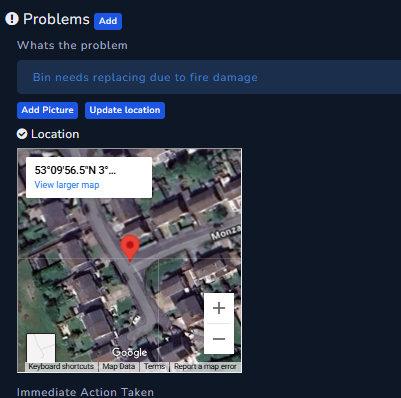
Every problem captures essential information in seconds — what the issue is, where exactly it’s located, how urgent it is, and photographic evidence. Location tracking records the specific facility, area and even equipment item affected, making it simple for maintenance teams or contractors to find and fix the problem without lengthy explanations or site visits to locate the issue.
Track problems from report to resolution with location intelligence
Logging problems is pointless if they disappear into a black hole. OpsPal ensures every issue is tracked through its entire lifecycle — from initial report through assignment, action and completion — with location data showing exactly where problems are concentrated across your leisure estate.
Automatic accountability and ownership
When a problem is logged, the system immediately assigns it to the responsible person based on issue type and location. Gym equipment faults go to fitness managers. Pool plant issues route to pool technicians. Building maintenance problems assign to facilities teams. Each owner receives instant email notification with full problem details, location and photographic evidence.
Owners can’t ignore or forget assigned problems — they appear prominently in their individual user area and on management dashboards. Clear accountability means every issue has a named person responsible for resolution, eliminating the “I thought someone else was dealing with it” excuse.
Location tracking reveals operational patterns
See where problems occur most frequently across your leisure centres. Identify which facilities generate the highest maintenance workload. Spot patterns showing specific areas or equipment types repeatedly failing. Discover whether issues are concentrated in particular leisure centres, revealing sites that need additional investment or more rigorous preventative maintenance.
Multi-site operators gain powerful insights from location data. Compare problem volumes across different leisure centres to identify high-performing sites and those needing support. Track whether issues are facility-wide (suggesting systemic problems) or location-specific (indicating local management or equipment issues). Use this intelligence to allocate maintenance budgets, plan equipment replacement programmes and target improvement initiatives where they’re needed most.
Complete visibility through dashboards
Live dashboards show all outstanding problems across your estate in real time. Filter by location, priority, type, owner or age. See which issues are overdue, which are in progress and which are awaiting parts or contractors. Management meetings drive outcomes because everyone can see exactly what needs addressing and who’s responsible.
Individual accountability dashboards ensure every team member sees problems they own, can’t claim ignorance of outstanding issues, and must actively update progress or mark completion. This transparency drives faster resolution and eliminates problems languishing unresolved for weeks.

Accelerate resolution with photographic evidence and communication trails
Maintenance issues often require multiple back-and-forth communications to clarify exactly what’s wrong, where it is and what’s needed. This delays resolution, frustrates staff and extends facility downtime. Photographic evidence transforms problem management by showing exactly what needs fixing before anyone travels to site.
Visual clarity speeds diagnosis and resolution
Staff photograph the problem when logging it — the broken treadmill belt, cracked pool tile, leaking changing room shower, damaged gym floor, faulty emergency light or malfunctioning access control. Maintenance teams or contractors see exactly what they’re dealing with before arriving on site, bringing correct parts, tools and expertise on the first visit.
When problems are resolved, completion photographs provide evidence that work was done to required standards. Compare before and after images to verify quality. Create audit trails showing the complete journey from problem identification through action to verified completion. This documentation is valuable for insurance claims, warranty disputes, contractor performance reviews and demonstrating systematic maintenance management to Quest assessors or landlords.
Clear communication prevents misunderstandings
All communication about each problem happens in one place — no more hunting through email threads or trying to remember verbal conversations. Staff add updates, ask questions and provide additional information directly on the problem record. Everyone involved sees the complete conversation history, ensuring continuity even when shifts change or different team members get involved.
Categorise problems for efficient management meetings and reporting. Tag issues as urgent safety concerns, routine maintenance, member complaints, equipment failures or facility improvements. Filter dashboards to focus meeting agendas on specific problem types. Generate reports showing problem volumes by category, helping prioritise resources and identify recurring issue patterns that need systemic solutions.
Email notifications keep everyone informed automatically. When problems are assigned, updated or completed, relevant people receive alerts without manual chasing. Managers know when issues are resolved. Staff who reported problems see their concerns were addressed. This closed-loop communication builds confidence that reporting issues leads to action, encouraging proactive problem identification rather than people ignoring defects because “nothing ever gets fixed anyway”.
Prevent problems falling through the gaps in multi-site operations
Single-site operators struggle with problem tracking. Multi-site leisure trusts, universities and independent operators face exponentially greater challenges — problems reported at one centre can easily be forgotten when management attention shifts to other locations. Email-based problem management becomes unworkable across multiple facilities.
Estate-wide visibility prevents issues being overlooked
OpsPal’s problem manager provides complete oversight of every outstanding issue across all leisure centres, swimming pools and sports facilities. Head office sees problems at every location simultaneously. Area managers filter dashboards to show sites they’re responsible for. Individual centre managers focus on their facility whilst senior leadership monitors the entire estate.
This visibility is transformational for multi-site operations. Discover centres where problems are piling up unresolved, indicating inadequate maintenance resources or management capability. Identify sites with very few logged problems, potentially revealing a culture where staff don’t bother reporting issues because they never get fixed. Spot systemic problems appearing at multiple locations, suggesting equipment flaws or procedural gaps needing centralised solutions.
Location intelligence helps allocate resources strategically. See which leisure centres consume the most maintenance time and budget. Identify facilities where investment in equipment replacement would reduce ongoing repair costs. Compare problem resolution speeds across locations to recognise high-performing teams and support underperforming sites.
Integration with wider operations management Problems don’t exist in isolation — they connect to risk assessments, compliance tasks, maintenance schedules and operational procedures. OpsPal integrates problem management with your entire operations system.
Problems trigger corrective action tasks automatically. A reported safety hazard generates an immediate task assigned to the duty manager with a completion deadline. Equipment failures create maintenance tasks tracked through to resolution. Member complaints initiate investigation tasks for management review.
Link problems to specific assets and equipment items. Track maintenance history for each treadmill, pool filter, boiler or access control point. Use this data to support equipment replacement business cases — showing that a troublesome pool plant has generated 37 logged problems in 12 months, justifying capital investment in replacement rather than continued repairs.
Problems inform preventative maintenance planning. Recurring issues with specific equipment types or building elements highlight where more frequent inspections, different maintenance approaches or equipment upgrades would reduce problem frequency. This data-driven approach moves you from reactive firefighting to strategic maintenance management.
Quest and compliance audit readiness
Demonstrate systematic issue management to Quest assessors, health authority inspectors and insurance auditors. Show how problems are logged, assigned, tracked and resolved with complete audit trails. Prove that safety concerns receive immediate attention. Evidence that member complaints are handled professionally with documented responses and actions.
The problem manager creates the permanent records assessors want to see — showing your organisation takes a professional, accountable approach to maintaining safe, high-quality facilities rather than relying on informal arrangements that leave issues unresolved.

Frequently Asked Questions
How does digital problem tracking improve accountability?
Digital problem tracking improves accountability by creating an auditable record of every issue from identification through resolution, with automatic timestamping, assigned responsibilities, and escalation mechanisms that prevent problems from being ignored or forgotten. Unlike verbal reports that can be denied or misremembered, or paper logbooks that might go unread, OpsPal’s problem management creates a permanent, searchable record of what was reported, who was responsible for resolution, what action was taken, and how long the problem remained open.
The accountability starts at the reporting stage. When a staff member identifies a problem (broken equipment, safety hazard, maintenance need, customer complaint), they log it through the mobile app with photos, location details, description. This report is immediately visible to their manager and assigned automatically to whoever’s responsible for that problem type (maintenance issues to the maintenance team, H&S concerns to the safety officer, customer service issues to the operations manager). The system timestamps the report, creating evidence that the organisation became aware of the issue.
Automatic assignment and tracking eliminate the “not my responsibility” problem common in leisure operations. If a lifeguard reports a pool hoist fault, it doesn’t sit in someone’s inbox waiting for them to decide who should fix it; the problem routes automatically to the equipment maintenance team. If a gym member reports aggressive behaviour from another customer, the complaint doesn’t rely on verbal handover between duty managers; it’s assigned formally to the senior manager responsible for disciplinary issues with full context and evidence.
The escalation system provides the crucial accountability mechanism. If an assigned problem isn’t updated within 24 hours (or whatever timeframe you configure based on severity), automatic reminders prompt the responsible person to provide a progress update or explanation for delay. If the problem remains unresolved beyond the expected timeframe, ensuring that stalled issues get attention rather than languishing forgotten in someone’s task list until the problem becomes serious.
Can staff report problems with photo evidence?
Yes, OpsPal allows staff to report problems with photo evidence directly from their mobile devices, capturing visual documentation at the moment they identify the issue and attaching it automatically to the problem report. This photo evidence capability is invaluable for leisure operations where describing problems in words often fails to convey severity, location, or specifics, particularly for maintenance issues, safety hazards, cleanliness concerns, and damage documentation.
The mobile reporting workflow makes photo capture effortless. When staff identify a problem (a damaged pool tile, worn gym equipment, a trip hazard, graffiti in changing rooms), they open the OpsPal app, select “report problem,” add photo directly using their device camera, describe the issue in text, and submit. The entire process takes under a minute, removing the friction that deters people from reporting issues when documentation feels time-consuming or bureaucratic.
Photo evidence eliminates ambiguity and disputes about problem severity. A maintenance team receiving a text report stating “pool deck tiles damaged near deep end” might dismiss it as minor, but receiving photos showing significant cracks with sharp edges immediately conveys the urgency and informs prioritisation decisions. A facilities manager investigating a customer complaint about changing room cleanliness can see photographic evidence of the actual conditions rather than relying on subjective descriptions that might be exaggerated or understated.
The photos become part of the permanent audit trail, providing evidence for incident investigations, insurance claims, and contractor disputes. If a customer slips on a wet surface and later claims the area was dangerously maintained, you can show photos taken during routine inspections demonstrating proper maintenance standards or conversely show evidence that the hazard was reported and scheduled for repair but the incident occurred before remedial work could be completed. This documentary evidence is often crucial for defending negligence claims or proving due diligence.
What happens to problems that aren't resolved on time?
Problems that aren’t resolved on time trigger automatic escalation notifications to the owner of the task and get highlighted so management can see there were not completed on time, ensuring stalled issues get attention rather than languishing forgotten until they become serious. OpsPal’s escalation system recognises that leisure operations face resource constraints and competing priorities but also that some problems can’t be allowed to remain unresolved indefinitely, particularly safety hazards, compliance issues, or matters affecting customer experience.
Senior management can escalate changes to the accountability dynamic. When a facilities manager receives notification that three maintenance problems in their area are overdue for resolution, they must either provide resources to address the backlog or document why resolution is delayed (budget constraints, awaiting contractor availability, specialist parts on order). This visibility prevents the common scenario where maintenance backlogs grow invisibly until a serious incident occurs or an external auditor discovers the accumulation of unresolved issues.
Critical problems receive accelerated escalation. A reported safety hazard like a loose pool ladder or defective fire alarm escalates within hours rather than days, and continues escalating to progressively senior managers until resolved or documented as mitigated. This ensures that health and safety risks get immediate attention regardless of other operational pressures.
How does OpsPal prevent problems being forgotten or ignored?
OpsPal prevents problems being forgotten or ignored through notifications, visible dashboards, and escalation markers that makes unresolved issues increasingly difficult to avoid until they’re addressed. The system recognises that in busy leisure operations, problems can slip through the cracks not through malice but through overwhelming workload, competing priorities, unclear ownership, or simple forgetfulness, and provides multiple safety mechanisms to ensure nothing falls through the gaps.
The first prevention mechanism is automatic assignment. When a problem is reported, it immediately appears in someone’s notification area . This transforms vague awareness (“I know there’s some maintenance needed”) into specific accountability (“I have a task due to repair the gym door lock”). The assigned person sees the problem prominently in their user area (Bell) until resolved, providing constant visual reminder that action is required.
Dashboard visibility provides organisational awareness beyond individual assignments. Managers can see all open problems in their area of responsibility, highlighted by age. A facilities manager with fifteen open maintenance items sees them, identifying which problems are becoming overdue and need prioritisation. This overview prevents the situation where a staff member reports a fault, it gets assigned, but then nothing happens because the recipient has too many competing demands and the problem gradually disappears from consciousness.
Even if an assigned person chooses to ignore their tasks and notifications, the manager can access the problem dashboard which ensures organisational awareness. Even if a manager is too busy to notice problems accumulating in their area, senior management dashboards flag departments with high numbers of aged problems, prompting intervention. This multi-layered approach ensures that issues remain hidden indefinitely due to the abundance of visibility mechanisms.
Can a maintenance/facilities manager have access to multiple sites?
Yes, OpsPal allows maintenance and facilities managers to have access to multiple sites simultaneously, providing a unified view of all problems, tasks, and maintenance activities across their entire estate from their individual user area. This multi-site access is essential for regional facilities managers, roving maintenance teams, or head office technical staff who support multiple leisure centres, enabling them to prioritise work efficiently, identify recurring issues, and allocate resources strategically across all locations they oversee.
The multi-site access works through flexible permission settings. A facilities manager can be granted access to specific sites (perhaps the three leisure centres in their region) or all sites organisation-wide if they provide central maintenance support. Their dashboard displays problems, maintenance tasks, and equipment issues from all assigned sites in one consolidated view, filterable by location. This means they can review all reported pool plant faults across five facilities simultaneously rather than logging into separate systems or requesting individual site reports.
The practical benefit is efficient resource allocation and workload planning. A roving maintenance technician starting their day can see that Site A has an urgent pool hoist repair, Site B has three routine equipment checks due, and Site C has a minor changing room door adjustment. They can plan their route logically, prioritise urgent issues, batch similar tasks together, and complete work across multiple sites efficiently rather than making unnecessary journeys or missing urgent problems because they weren’t visible until they physically arrived at a site.
Multi-site access also enables pattern recognition and preventative maintenance improvements. If the same pool pump model fails repeatedly across three different sites, the facilities manager sees this pattern in their consolidated problem view and can arrange proactive replacement at remaining sites before additional failures occur. If one site’s maintenance backlog is growing whilst others are current, the facilities manager can redistribute work or identify whether that site needs additional resources or has underlying issues requiring attention. This strategic oversight transforms facilities management from reactive site-by-site firefighting to proactive estate-wide maintenance planning.
Book a Call With Our Team
We’re on hand for any questions you may have. Simply book a meeting using our booking system and we will talk you through any questions.