Why Frontline Performance Problems Are Usually a Management Problem in Disguise
The most common management response to performance challenges in leisure facilities is to look at frontline behaviour first. This guide inverts that instinct.
You’ve just reviewed last month’s numbers. Scanning compliance is down. Complaint response times are up. Retention’s slipping. So what’s the first thing that gets looked at? Frontline behaviour. Every time. It’s the default instinct in leisure management — and it’s usually the wrong place to start. Before you pull a member of staff into a conversation about their performance, ask yourself a harder question: what did management actually do to make that standard possible?
The Ceiling Problem
Leadership behaviour sets the ceiling for everything else in your facility. Frontline staff can only perform to the level that management consistently makes possible — through auditing, supervision, structured feedback, and visible standards. When those things are missing, compliance drifts. Not because staff don’t care, but because the environment stops holding the standard.
This isn’t about blame. It’s about accurate diagnosis.
When scanning compliance drops at a leisure centre, the instinct is to retrain the reception team. But if nobody in a management role has audited scanning rates in the last four weeks, what exactly is the retraining solving? The behaviour wasn’t the root cause. The absence of oversight was.
Three Common Symptoms — and What They’re Actually Telling You
Symptom 1: Low scanning compliance
Before you assume staff are cutting corners, ask whether scanning compliance appears on any management audit. Is it being checked weekly? Is there a target? Does anyone review the data and feed it back to the team? If the answer is no, you haven’t got a frontline problem. You’ve got a management visibility problem.
Symptom 2: Dropping retention
Member retention conversations are one of the most powerful tools a leisure facility has — and one of the most inconsistently applied. If retention is falling, the question isn’t just “are staff talking to at-risk members?” It’s “are supervision conversations happening that coach staff on how to have those conversations?” Retention is a skill that needs to be developed deliberately, not assumed.
Symptom 3: Poor complaint response times
Slow complaint resolution is rarely about staff attitude. It’s almost always about process. Is there a structured review system? Does the duty manager know what a resolved complaint looks like within 24 hours? If the process doesn’t exist, or exists only on paper, you can’t hold the front line to a standard that management never established clearly.
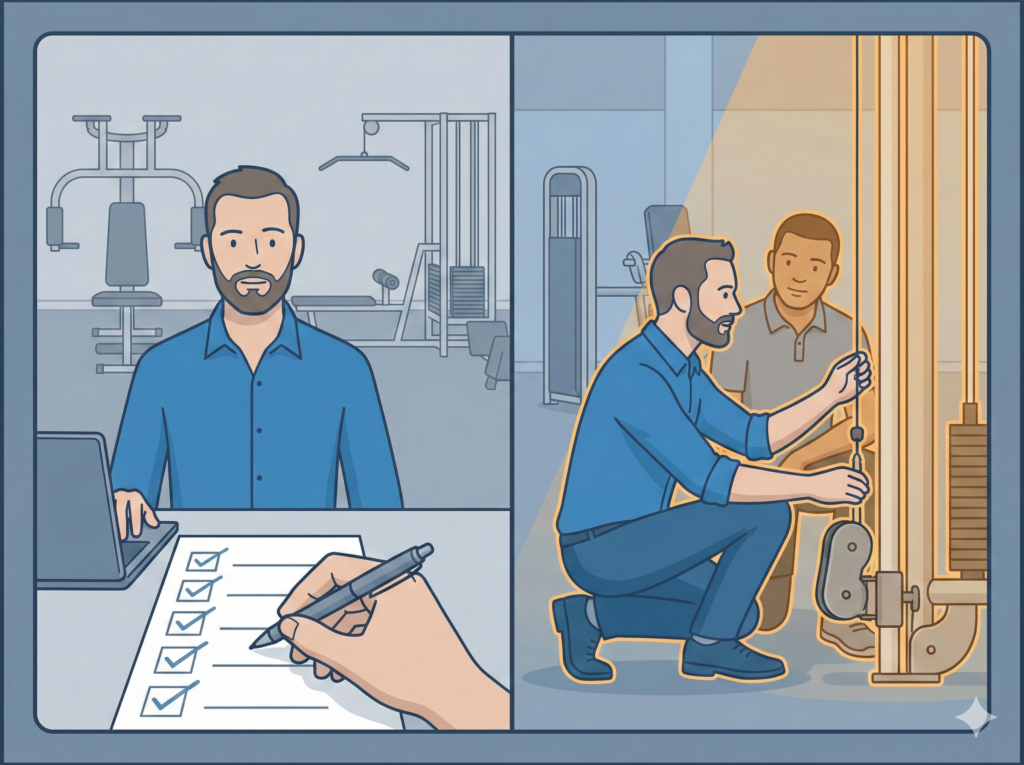 “Bad checking Tasks / Good checking Tasks”
The Difference Between Checking and Actually Checking
Here’s where it gets uncomfortable. Most leisure managers aren’t actually as good at checking frontline behaviour as they think they are — they’re good at confirming it happened. There’s a significant difference.
Bad checking asks: “Has the pool test been done?” The log says yes. Job done. Move on.
Good checking asks: “Has the pool test been done?” The log says yes. “Right — let’s go and have a look then.”
One is administration. The other is management. The first gives you a signature. The second gives you a standard.
This matters because staff learn very quickly what gets genuinely inspected and what just gets signed off. If pool tests are logged but never walked, the log becomes the standard — not the test itself. The same applies to cleaning schedules, equipment checks, session quality, and every other operational routine you rely on.
There are two distinct levels of oversight that both need to happen. Audits — the formal, structured reviews — matter, but in most facilities they happen when they have to: before a Quest inspection, after an incident, when someone above you is visiting. The rest of the time, it’s the daily checks of the checks that hold standards. Walking the floor. Asking the follow-up question. Making it normal for management to look, not just ask.
Are supervision conversations happening on schedule? Is the management team present at the times that matter — not just peak hours when everything looks fine, but at 7pm on a Tuesday when standards quietly slip? Are complaint trends being reviewed structurally, or just individual complaints being closed and forgotten?
If you can’t answer those questions with evidence rather than assumption, that’s your starting point.
What Deliberate Measurement Looks Like
The facilities that consistently perform well tend to do one thing differently: they measure management behaviour with the same rigour they apply to frontline behaviour.
That means tracking whether audits actually happened, not just whether the audit sheet exists. It means recording when supervision conversations took place and what was covered. It means reviewing complaint response times at a management level, not just flagging individual cases.
None of this requires complex systems. It requires discipline and visibility. A simple dashboard showing whether this week’s management actions were completed or outstanding changes the conversation entirely. It moves you from reacting to poor frontline performance to preventing it.
The Harder Conversation
Here’s the thing nobody enjoys saying out loud: if standards in your facility are consistently below where they should be, and your frontline team is reasonably trained and well-intentioned, the gap is almost certainly in management behaviour. Not as a moral failing — as a systems failure.
People don’t make mistakes on purpose. They operate to the standard the environment makes normal. If management isn’t auditing scanning, scanning drifts. If supervision conversations aren’t happening, coaching doesn’t land. If complaints aren’t being reviewed structurally, response times stay poor.
Fix the environment, and the frontline usually fixes itself.
The Monday Morning Action
This week, before you look at any frontline performance metric, audit your management actions from the last four weeks. Pick three standards that matter to you — scanning compliance, supervision conversations, complaint review — and ask honestly: did management do what was needed to hold those standards?
If the answer is no, you’ve found your starting point. And it’s not a conversation with a member of staff. It’s a conversation with yourself.
OpsPal gives leisure managers the visibility to track not just what frontline staff are completing, but whether the management actions that underpin performance are actually happening — audits, reviews, task completion, outstanding problems. If you want to see what that looks like in practice, book a demo.
Sources