Nobody Teaches You This
I wrote a guide last year that I never expected to write.
Eleven steps. How to use your operations platform to actually manage your team — not just run the system, but lead with it. Read the data. Run the 1-to-1s. Spot the patterns before they become problems.
I thought it was obvious. Turns out it wasn’t. And the more people I talked to, the clearer it became: this isn’t a technology problem. It’s a training gap that nobody’s filling.
We Train People for Everything Except This
In leisure, we’re good at training. Lifeguarding. First aid. Food hygiene. Safeguarding. NOP familiarisation. Manual handling. We have frameworks for all of it — qualifications, sign-offs, renewal dates, the lot.
And then we promote someone into a management role. We hand them login credentials for the operations system. We show them how to create a task or log a problem. And we assume the rest will follow.
It doesn’t.
Because knowing how to use a system and knowing how to manage with it are completely different skills. One is operational. The other is leadership. And almost nobody in our sector gets taught the second one.
I’ve seen it across dozens of sites. A leisure centre invests in digital operations software. The system is set up properly. The tasks are loaded, the checklists are live, the dashboards are working. And six months later, the management team is still running their shifts the way they did on paper. The data is there. Nobody’s using it.
That’s not a technology failure. That’s a training gap. And it’s one we created ourselves by assuming that digital competence and management competence are the same thing.
The Credibility Problem Nobody Talks About
Here’s something the guide starts with, because it matters more than anything else: you cannot manage a system you don’t use yourself.
If your managers are coaching their teams on task completion rates while they haven’t logged into the system themselves this week, the team knows. It always shows. And the moment a manager loses credibility on the tool, they lose the ability to use it as a management lever.
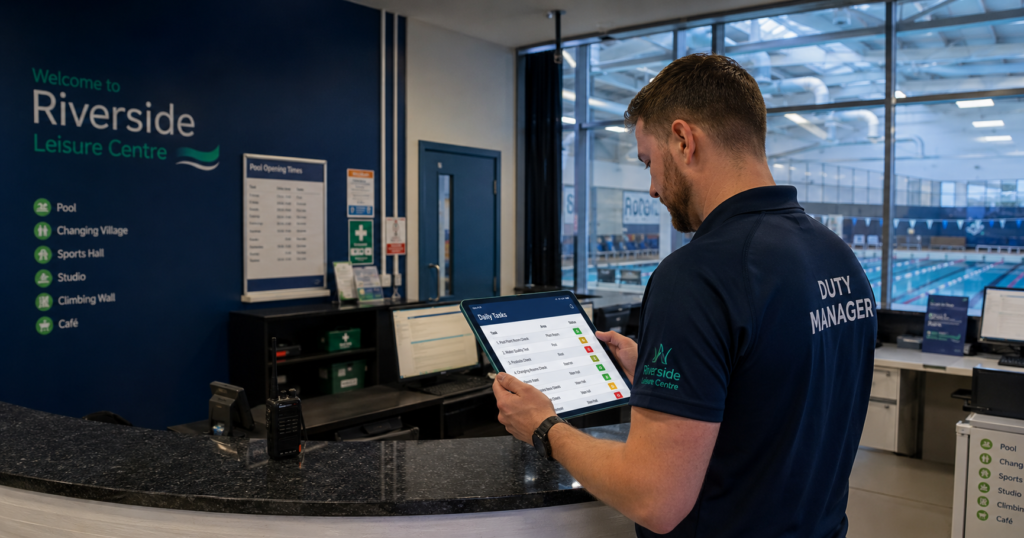
The first step — genuinely the first step — is that every manager using OpsPal to lead a team needs to be active on the platform themselves. Not as an auditor checking what others have done. As a user, doing the things they’re asking their team to do.
This sounds obvious. It’s routinely skipped.
The 7-Day Report Is Not a Compliance Check
Most managers who do look at their data treat it as a compliance check. Green is good, red is bad, anything amber needs chasing. That’s not management. That’s monitoring.
The 7-day report exists to show you patterns. Which tasks are consistently being missed? Is it the same time of day? The same team? The same area of the building? Is the pattern consistent across the week, or does it appear on certain shifts?
A completion rate of 72% tells you almost nothing on its own. A completion rate of 72% that drops to 41% every Saturday morning tells you exactly where to look.
The operations dashboard in OpsPal is built to surface these patterns — not just to tell you what happened, but to help you understand why. That’s only useful if the person reading it knows what questions to ask.
The 30-day report goes further. It gives you enough data to see whether an intervention actually worked. Made a change to a process three weeks ago? The 30-day report will tell you whether completion improved. That’s the feedback loop that turns management decisions into management learning.
The Handover Is Where It Falls Apart
If you want to identify the single moment where operational information is most consistently lost in a leisure facility, it’s the shift handover.
Two managers. Fifteen minutes. One heading home, one starting six hours. In a paper-based environment, the outgoing manager scribbles a few notes, mentions a couple of things, and leaves. The incoming manager is already thinking about what’s on their shift.
McDonald’s cracked this decades ago. Before any McDonald’s manager leaves a shift, they complete a structured handover that the incoming manager reads and signs off. It’s not optional. It’s not a courtesy. It’s the mechanism that keeps operational standards consistent regardless of who’s in the building.
In OpsPal, the Problems Manager page does this job. Outstanding problems, logged and visible. Anything raised on the previous shift that hasn’t been resolved is sitting there, timestamped, waiting for the incoming manager. Nothing disappears because someone forgot to mention it.
The managers who use this well treat it as the first thing they check when they start a shift — not the last. They’re not waiting to be told what’s outstanding. They’re reading it.
Data as a 1-to-1 Tool
Most performance conversations in leisure management happen based on gut feel. The manager has a sense that someone’s engaged or disengaged, reliable or unreliable, improving or not. The staff member has a different sense. Both of them are working from memory and impression.
OpsPal’s individual user profiles change this completely. Every team member has an activity record — tasks completed, problems logged, documentation read and acknowledged. When you sit down for a 1-to-1, you’re not relying on your memory of the last month. You’re looking at the data.
This doesn’t mean turning a 1-to-1 into an interrogation. It means the conversation has something real to stand on. If someone’s completion rate has dropped over the past three weeks, that’s worth understanding — is it workload? Confidence? Something going on outside work? You can’t have that conversation properly if you don’t know there’s a pattern to investigate.
And when someone’s performing well — consistently completing, logging problems, reading procedures — the data lets you say that specifically. Not “you’ve been doing well lately” but “your completion rate this month is 94% and you’ve logged more problems than anyone else on the team.” That’s the kind of recognition that means something.
What Low Completion Rates Are Actually Telling You
This is the part that makes some managers uncomfortable.
When task completion rates are low across a team or a site, the instinct is to blame workload. Too many tasks, not enough staff, unrealistic expectations. Sometimes that’s true — and the data will show it, because you’ll see high completion rates on low-traffic days and low rates when the building is busy.
But sometimes — more often than people want to acknowledge — low completion rates are a leadership indicator. They tell you that the team doesn’t believe it matters. That nobody’s checking. That the tasks feel like box-ticking rather than genuine operational standards.
The way a manager responds to missed tasks shapes the culture of the entire team. If nothing happens when a task is missed, the message is that it wasn’t really important. If missed tasks are noticed, logged, and discussed — not punitively, but consistently — the message is that standards are real and held evenly.
The task management dashboard makes missed tasks visible in real time. What managers do with that visibility is where culture is made or lost.
The Guide I Wrote Because Nobody Else Did
All of this — the 11 steps, the reporting loops, the 1-to-1 frameworks, the handover principle, the culture indicators — is in the guide I ended up writing.
I called it Managing Your Team Through OpsPal. It started as an internal OpsHelp document. Then I shared it with a few clients. Then more people asked for it. And eventually it was clear that it needed to be available to anyone who needed it, because the gap it fills isn’t specific to OpsPal. It’s a gap in how we develop leisure managers full stop.
You can download the full guide here — it’s free. [View Here: Managing Your Team Through OpsPal →]
It covers all 11 steps in full, with practical guidance on reading the data, running the reports, and using what you find to actually lead. Whether you’re an experienced manager getting to grips with a digital system, or someone newer to the role who wants a framework for managing with evidence rather than instinct — it’s written for you.
Monday Morning. One Question.
Walk into your building tomorrow. Find your duty manager. Ask them one thing.
“What did last week’s data tell you that you’ve acted on?”
If they can answer that specifically — a pattern they spotted, a change they made, a conversation they had as a result — you’ve got a manager who’s leading with data. That’s exactly where you want to be.
If they can’t, you don’t have a performance problem. You have a training gap. And now you know exactly where to start.
Trusted by 50+ UK leisure operators. See how OpsPal works or explore the features.