
ESG Software | Embed Sustainability into Daily Operations
OpsPal ESG software turns sustainability pledges into measurable operational practice — tracking environmental compliance, workforce wellbeing and governance evidence across all sites to support GRI, TCFD, SASB and CDP reporting frameworks. See how BH Live have used OpsPal








































Environmental: Track sustainability initiatives with operational data
Environmental commitments
Require more than aspirational targets — you need systems that capture actual consumption, measure reduction progress, and link sustainability goals to frontline operations.
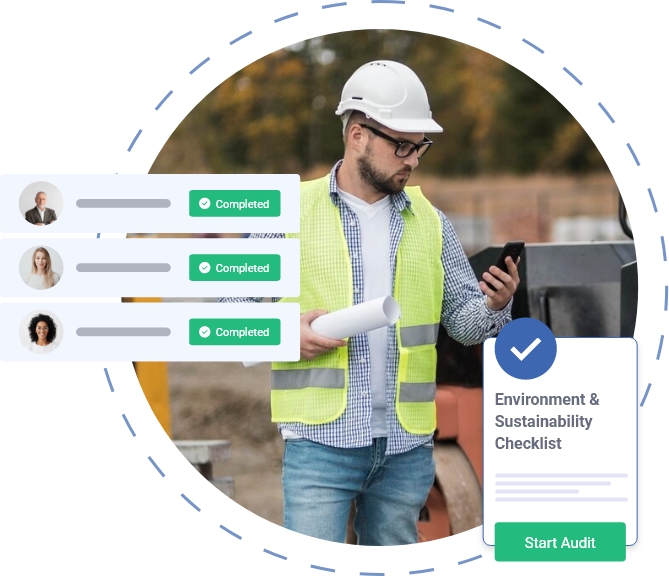
Digital operations eliminate paper-based checklists, inspection forms and compliance documentation. Beyond removing thousands of printed pages annually, digital systems reduce time wasted on administration—cutting the environmental costs of inefficient processes.
Track environmental compliance tasks and capture data for ESG reporting. Monitor energy consumption through meter readings integrated into scheduled tasks. Record waste volumes and recycling rates through operational checklists. Track water usage where consumption matters for environmental targets.
This operational data provides evidence
For environmental reporting frameworks (TCFD, CDP, GRI) without creating separate measurement systems. Your day-to-day operations generate the metrics ESG stakeholders demand — energy efficiency improvements, waste reduction progress, resource consumption trends and environmental incident rates.
Manage environmental permits, licences and regulations through automated tracking. Link environmental incidents to investigation workflows and corrective actions. Track near-misses that could have caused environmental harm. Use this data to demonstrate proactive environmental risk management and continuous improvement.
Social: Evidence workforce wellbeing and ethical operations
The social pillar of ESG encompasses how you treat employees, ensure workplace safety, support development and promote equity. OpsPal provides the systems and evidence demonstrating genuine commitment to social responsibility.
Systematic health and safety management is a fundamental social responsibility. Digital risk assessments ensure hazards are identified and controlled. Incident reporting captures accidents and near misses. Training matrices prove staff competency and development. This integrated approach demonstrates a duty of care toward employees — a core ESG social metric.
Track workplace wellbeing indicators through operational data. Monitor incident rates, near-miss reporting frequency and training completion. High near-miss reporting combined with low incident rates indicates a positive safety culture. Training investment demonstrates commitment to workforce development.
Problem reporting and issue management give every team member a voice. Staff can raise concerns about safety, ethics, working conditions or operational improvements knowing their input will be acknowledged and addressed. Track response times and resolution rates — showing whether your organisation genuinely listens to workforce concerns.
Training matrices show how you develop workforce capability beyond mandatory compliance training. Track skills development, career progression support and opportunities provided equally across different demographic groups. Location-based training data reveals whether development opportunities are distributed fairly across sites or concentrated in certain locations.

Governance: Provide transparency and accountability evidence
ESG governance requirements focus on decision-making transparency, accountability, regulatory compliance and ethical operations. Digital operational systems create the audit trails and evidence demonstrating good governance principles.
Every action in OpsPal links to an individual user at a specific time and location. You are aware of who completed compliance tasks, when, where, and the outcomes. When problems are reported, you track who investigated, what actions were taken and whether issues were resolved. This transparency prevents governance failures that occur when accountability is unclear.
Risk assessment, incident management and corrective action systems provide evidence of structured risk governance. Show how risks are identified, assessed, controlled, and monitored throughout the organisation. Prove that significant incidents trigger investigation and learning. Demonstrate that control failures lead to corrective actions tracked to completion.
Compliance tracking for health and safety, environmental permits, food safety and industry-specific regulations demonstrates governance capabilities. Automated deadline tracking shows you don’t miss regulatory obligations. Generate compliance reports instantly for boards, audit committees, regulators or certification bodies.
Digital procedure management ensures the consistent application of organisational policies across all sites. Track who has read and acknowledged policies — demonstrating communication of standards. Maintain version control showing policy updates are deployed promptly. This documentation supports governance requirements around policy dissemination and compliance.
ESG Software for Reporting and Stakeholder Confidence
ESG reporting frameworks
(GRI, SASB, TCFD, CDP) require evidence-based disclosures about environmental impact, social responsibility and governance practices. Organisations face increasing pressure from investors, regulators, customers and employees to demonstrate genuine ESG performance.
Traditional ESG reporting relies on estimates, surveys and retrospective data collection. OpsPal enables ESG reporting based on actual operational data — metrics generated automatically from daily operations rather than created specifically for ESG disclosure.
Environmental metrics come from operational tracking of energy use, waste volumes and resource consumption. Social metrics derive from health and safety performance, training investment and incident rates. Governance evidence flows from compliance tracking, risk management and audit trails. This operational foundation reduces reporting burden whilst increasing data quality and stakeholder confidence.
Different stakeholders require different ESG reporting frameworks. Operational data provides the raw material for multiple frameworks without creating separate data collection processes for each. Extract the metrics different frameworks require from the same underlying operational systems.
For organisations operating multiple sites, OpsPal’s location tracking shows environmental compliance, safety performance and governance practices at each site. Identify high-performing locations and support sites needing improvement. Prove that ESG commitments apply across your entire estate, not just flagship locations.
By integrating ESG requirements into operational systems, you reduce duplicated effort, improve data quality and ensure ESG commitments connect to daily activity rather than existing as separate strategic documents disconnected from operational reality.
Frequently Asked Questions
What is ESG software?
ESG software is a digital platform that helps organisations implement environmental, social and governance initiatives through operational systems rather than just strategic commitments. Instead of ESG remaining a boardroom concept disconnected from daily operations, the software embeds sustainability practices into procedures, tasks, training and communications—ensuring frontline teams understand and implement ESG goals whilst providing headquarters with visibility of actual practice across operations.
The platform addresses ESG through OpsPal’s existing operational management capabilities. Digital procedures communicate sustainability practices throughout the organisation, replacing paper-based systems to eliminate waste whilst ensuring teams follow consistent methods. Task management schedules and tracks sustainability activities—energy monitoring, waste reduction checks, equipment efficiency inspections—with dashboard visibility showing completion rates. Training matrices ensure staff have the qualifications and knowledge ESG initiatives require. Problem management logs issues with photo evidence, tracking improvements through to completion.
Different organisations prioritise different ESG elements. Manufacturing sites focus on energy consumption, waste management and environmental footprint reduction. Leisure facilities emphasise community engagement, accessibility and social responsibility alongside operational efficiency. Retail operations track resource consumption, ethical supply chain standards and governance transparency. The software consolidates operational data into one location, making it easier to identify improvement areas, make informed decisions, and translate ESG commitments into measurable operational practice.
The fundamental value is making ESG pledges operational rather than aspirational. When sustainability targets exist only in annual reports, operational teams don’t know what actions they’re responsible for. Digital systems make ESG activities visible and trackable—procedures embed sustainability practices, tasks schedule environmental monitoring, training ensures staff understanding, and dashboards show whether initiatives are actually implemented. This operational approach creates the transparency stakeholders increasingly demand whilst reducing operational waste through streamlined digital processes.
How does ESG software help organisations meet sustainability goals?
ESG software helps organisations meet sustainability goals by embedding environmental, social and governance initiatives into daily operational tasks rather than treating sustainability as separate reporting exercises. Digital procedures communicate sustainability practices to frontline teams—energy efficiency protocols, waste reduction methods, resource conservation techniques—ensuring everyone understands their role in achieving ESG targets. Task management schedules environmental monitoring activities like equipment efficiency checks, waste audits and resource consumption tracking as recurring tasks with dashboard visibility showing completion status.
The platform eliminates paper consumption whilst creating operational efficiency. Replacing paper-based procedures, checklists and filing systems with digital alternatives directly reduces environmental footprint. Streamlined task management and reporting reduces time and material waste—staff access procedures on any device rather than printing documents, managers see operational status through dashboards rather than compiling spreadsheet reports, and audit trails are generated digitally rather than maintained in physical filing cabinets.
Training and communications accelerate sustainability adoption throughout the organisation. Staff receive in-app bell notifications when sustainability procedures are updated and must acknowledge changes, creating audit trails showing ESG practices reach the people who need to implement them. Training matrices track qualifications relevant to sustainability initiatives—environmental management certifications, energy efficiency training, waste management competencies—with colour-coded status showing which staff have current knowledge.
Consolidating operational data into one location makes improvement areas visible. Dashboard indicators show task completion rates for environmental monitoring, training compliance for sustainability knowledge, and problem logs identifying where operational efficiency falls short of ESG targets. This visibility helps organisations make informed decisions about where to direct sustainability efforts, demonstrating to stakeholders that ESG commitments translate into measurable operational practice rather than remaining strategic aspirations disconnected from daily operations.
What are the key components of ESG management software?
ESG management software combines digital procedures, task management, training tracking and operational reporting to embed environmental, social and governance initiatives into daily operations. Digital procedures store sustainability protocols—energy efficiency methods, waste reduction practices, resource conservation techniques, ethical governance policies—with version control tracking all changes. When procedures are updated to reflect new sustainability standards or regulatory requirements, staff receive in-app bell notifications and must acknowledge changes, creating audit trails showing ESG practices reach frontline teams.
Task management schedules and tracks sustainability activities as recurring operational tasks. Environmental monitoring like equipment efficiency checks, waste audits, energy consumption tracking and resource usage reviews are assigned with dashboard visibility showing completion status. Colour coding indicates which tasks are available (green), started but not overdue (amber), overdue (red), or completed (grey). When staff leave the organisation, the system automatically transfers their tasks to replacements, ensuring sustainability monitoring continues regardless of staff changes.
Training matrices track qualifications and knowledge relevant to ESG initiatives at three levels—individual staff records accessible through the notification bell, team reports showing sustainability competencies for specific departments, and organisation-wide dashboards showing training compliance across all sites. Colour coding indicates whether environmental management certifications, energy efficiency training or governance knowledge is current (green), expiring within 90 days (amber), or expired (red). This visibility ensures staff maintain the competency ESG initiatives require.
Problem management logs operational inefficiencies, sustainability issues and governance concerns with photo evidence and location verification. Dashboard visibility tracks problems through to resolution, showing whether environmental issues are addressed quickly or left outstanding. Log reports filtered by date range provide historical evidence of sustainability task completion, training compliance and problem resolution—demonstrating to stakeholders that ESG commitments translate into measurable operational practice maintained consistently over time.
How do you report on ESG performance to stakeholders?
Reporting on ESG performance to stakeholders requires demonstrating that environmental, social and governance commitments translate into measurable operational practice rather than remaining strategic aspirations. ESG software generates evidence through log reports filtered by date range showing sustainability task completion—which environmental monitoring activities occurred, by whom, when, and at which location. Staff acknowledgement reports prove frontline teams have read and understood sustainability procedures rather than assuming communication occurred. Training matrix reports show ESG-related qualifications and competency across teams or the entire organisation.
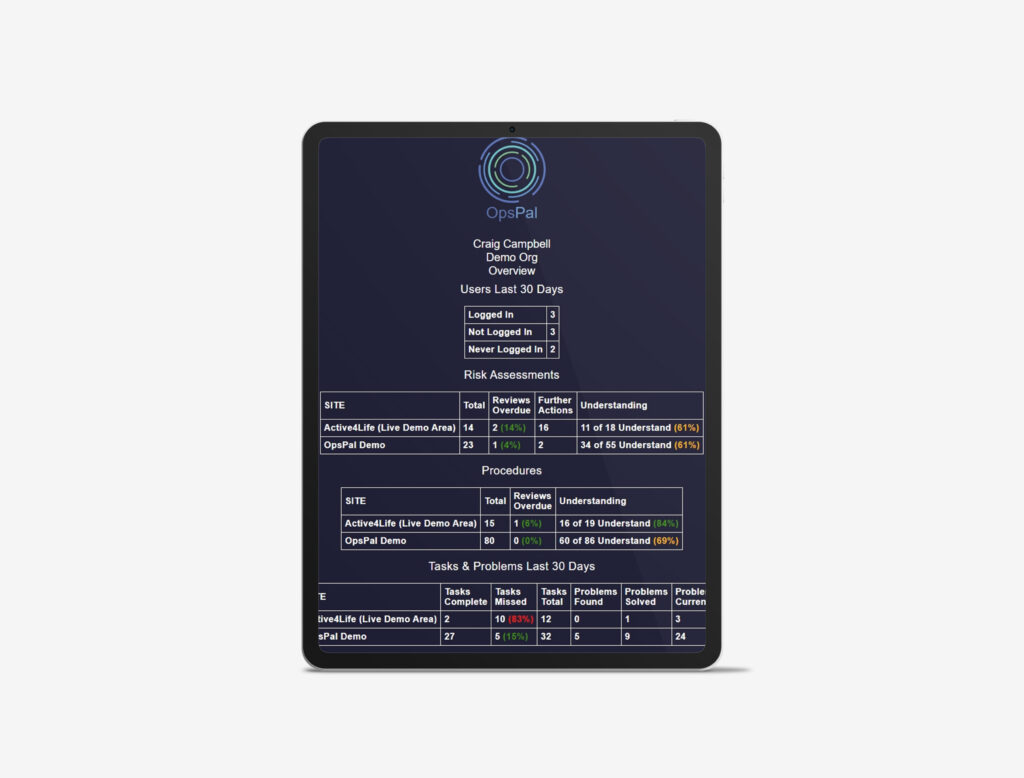
Dashboard visibility provides real-time insight into ESG implementation. Task completion rates show whether environmental monitoring, waste audits and resource efficiency checks happen consistently. Training compliance indicators reveal which staff maintain sustainability knowledge and which have expired certifications. Problem logs demonstrate how operational inefficiencies and environmental concerns are identified and resolved. This continuous operational data creates transparency that stakeholders increasingly demand when evaluating corporate ESG credentials.
The platform’s digital approach itself contributes to environmental reporting. Eliminating paper-based procedures, checklists and filing systems directly reduces environmental footprint—a tangible sustainability outcome stakeholders can measure. Streamlined operations reduce time and material waste. Consolidated data in one location makes improvement areas visible, supporting informed decision-making about where to direct sustainability efforts. Manager overview emails provide regular summaries with key performance indicators, creating ongoing ESG visibility without manual compilation.
ESG reporting aligns with global standards by demonstrating systematic environmental, social and governance management through frequent assessments and continuous operational evidence. When investors, customers or regulators request ESG credentials, log reports generate comprehensive documentation showing sustainability activities are genuinely maintained daily rather than temporarily adopted when stakeholders ask questions. This systematic approach creates the accountability and transparency modern ESG frameworks require.
Why do organisations need ESG software?
Answer:
Organisations need ESG software because environmental, social and governance commitments disconnected from daily operations remain strategic aspirations that don’t translate into measurable practice. When sustainability goals exist only in annual reports or boardroom presentations, frontline teams don’t know what actions they’re responsible for implementing. When ESG data lives in disconnected spreadsheets compiled annually for stakeholder reporting, organisations can’t track whether initiatives actually work or identify where improvements are needed. This gap between ESG commitments and operational reality is where greenwashing accusations emerge—stakeholders increasingly demand evidence of genuine sustainability practice, not marketing statements.
Investors, customers and regulators prioritise ESG credentials when evaluating organisations. Investment decisions consider environmental stewardship, social responsibility and governance transparency. Customers choose suppliers with verified sustainability practices. Regulatory frameworks like SECR (Streamlined Energy and Carbon Reporting) mandate specific disclosures. ESG software provides the systematic evidence these stakeholders require—log reports showing environmental monitoring occurs consistently, training matrices demonstrating staff maintain sustainability competencies, and problem logs revealing how operational inefficiencies are addressed.
The platform’s digital approach creates direct environmental benefits whilst embedding ESG practices operationally. Eliminating paper-based procedures, checklists and filing systems reduces environmental footprint immediately. Digital task management ensures sustainability activities like equipment efficiency checks, waste audits and resource monitoring happen consistently, with dashboard visibility showing completion status. Procedures communicate sustainability practices throughout the organisation, accelerating ESG adoption from headquarters to frontlines. Training tracking ensures staff understand their ESG responsibilities.
The fundamental business value is making sustainability measurable and manageable rather than aspirational. When organisations consolidate operational data in one location, improvement areas become visible. Dashboard indicators show task completion rates for environmental monitoring, training compliance for sustainability knowledge, and problem resolution tracking operational inefficiencies. This transparency helps organisations make informed decisions about sustainability investments whilst providing stakeholders with the evidence they increasingly demand—demonstrating that ESG commitments translate into genuine operational practice maintained consistently over time.
Book a Call With Our Team
We’re on hand for any questions you may have. Simply book a meeting using our booking system and we will talk you through any questions.