Your Wage Bill Just Went Up. Your headcount didn’t. Here’s What Breaks First.
On the 1st of April, your wage bill goes up. Not by a little — for many leisure operators running on hourly contracts, the April National Living Wage increase will add tens of thousands to annual payroll overnight. Most managers already know this. What they haven’t fully worked out yet is what breaks next.
It won’t be the budget spreadsheet. It’ll be the handover that doesn’t happen properly. The risk assessment nobody signed off. The pool plant log is two days behind because the person who usually does it is now covering two roles instead of one. Wage increases don’t just cost money. They expose every weakness in how you run the place.
The Real Cost Isn’t the Wage Bill
From 1 April 2026, the National Living Wage rises to £12.21 per hour for workers aged 21 and over. For a leisure centre running 20 hourly-contracted staff at 30 hours a week, that’s a conservative annual increase of around £20,000 — before you factor in National Insurance contributions, which rose in April 2025 and haven’t gone back down.
The sector has been here before. Every time the wage floor moves, the same conversation happens: review the rota, reduce hours where you can, and freeze that vacancy a bit longer. That’s understandable. Margins are tight and the options are limited.
But here’s what that conversation almost always misses. The compliance burden doesn’t shrink when the team does. Your risk assessments still need reviewing. Your procedures still need reading and acknowledging. Your pool plant logs still need completing every session. Your qualification matrix still needs keeping current. Your task schedule – opening checks, equipment inspections, and cleaning routines – doesn’t get shorter because you’ve got fewer people to do it.
What actually happens is that the same operational workload gets distributed across a thinner team. And when that happens, things slip — not because your staff are careless, but because there are only so many hours in a shift.
What Actually Breaks When Teams Get Leaner
Let’s be specific, because this is where it gets real.
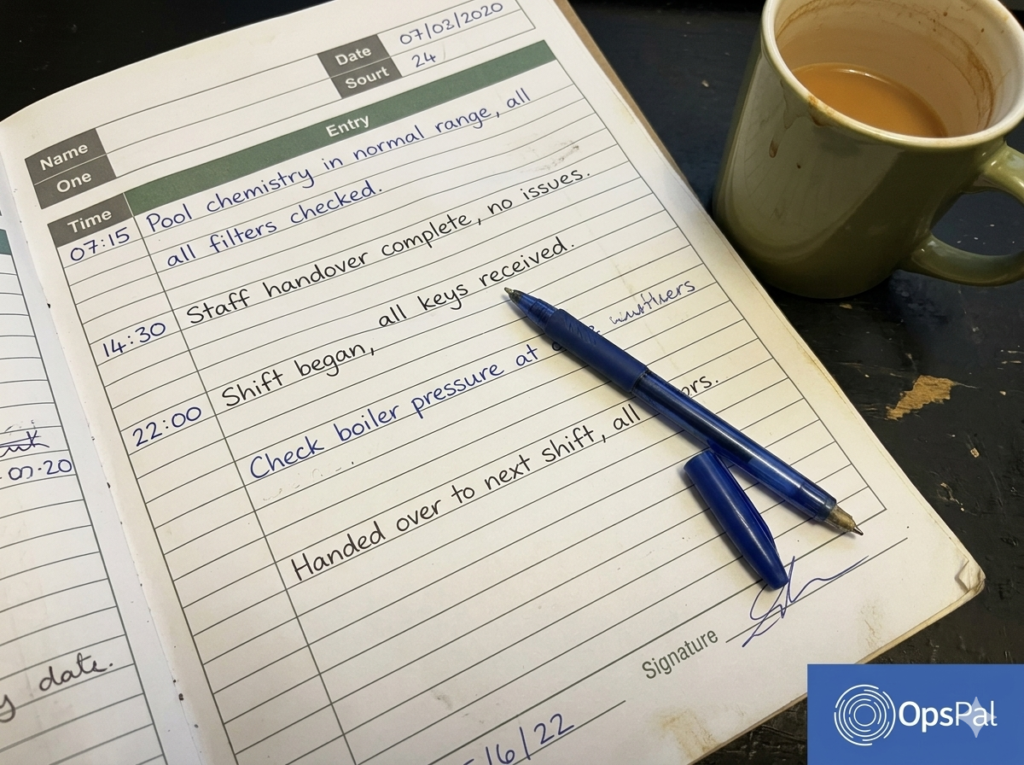
Handovers. When you’re short-staffed or running on a tight rota, handovers are the first thing that gets cut short. “I’ll fill in the log later” becomes “I didn’t get a chance.” Your incoming duty manager starts their shift without knowing the pool heater has been playing up or that the fire exit on the east side was temporarily blocked and hasn’t been checked since. Nothing has gone wrong yet. But the visibility has gone.
Risk assessment sign-offs. If your risk assessments live in a folder — or even a shared drive somewhere — the chances of staff actually reading and acknowledging an updated document are low at the best of times. Add in a stretched team and it becomes almost zero. You might have the paperwork. You almost certainly won’t have the evidence that staff have read it.
Qualification tracking. This one catches operators out more than almost anything else. An NPLQ that expired three months ago. A first aid certificate that nobody noticed had lapsed. When you’ve got stable, long-serving staff, you can sometimes stay on top of this manually. When you’re running seasonal workers, covering vacancies, and onboarding new starters in a rush, a spreadsheet simply doesn’t cut it. The HSE doesn’t accept “we were short-staffed” as a mitigating factor.
Problem resolution. Something gets reported. It goes on the whiteboard, into the handover book, or into a group WhatsApp. Nobody is clearly responsible. A week later, it’s still there — or it’s been rubbed off the whiteboard and quietly forgotten. In the meantime, if something happens in that area, you’ve got no evidence of action and no audit trail.
The Invisible Overhead Nobody Talks About
There’s a management time cost buried in all of this that rarely gets discussed properly.
When operational systems are manual—paper logs, shared drives, spreadsheets, WhatsApp groups—somebody has to chase them. That somebody is usually your duty manager or ops manager. They’re spending time every shift checking what’s been done, following up on what hasn’t, and trying to piece together a picture of what’s actually happening across the building. In a multi-site operation, that problem multiplies.
UKActive has consistently highlighted that the administrative burden on leisure managers is a significant factor in both burnout and retention issues. When your best people are spending hours a week on compliance administration that a decent system could handle, you’re paying twice — once for their time, and once for the risk you’re carrying.
With wages rising and headcount staying flat, that management overhead gets heavier, not lighter. Every hour your duty manager spends chasing a sign-off or reconstructing last week’s task completion history is an hour they’re not on the floor, not with members, not developing their team.
This Isn’t a Staffing Problem
Here’s the thing. The issues above aren’t caused by having too few staff. They’re caused by running an operation that depends on having enough staff to hold it together manually.
Paper systems, shared drives, and handover books work reasonably well when you’ve got consistent, experienced teams and enough hours in the day. They start to fall apart the moment you apply any pressure – a vacancy, a busy peak period, a round of wage-driven rota changes. The system isn’t strong enough to absorb the shock.
The leisure centres and trusts that handle cost pressures best aren’t the ones with the biggest budgets. They’re the ones whose operations don’t rely on individuals remembering things, chasing things, or being in the right place at the right time. Their compliance is visible whether they’re there or not. Their tasks get done because the system makes it clear what’s outstanding, who’s responsible, and when it’s overdue—without anyone having to chase.
That shift — from operations held together by people to operations supported by systems — is what protects you when your team gets leaner.
Where OpsPal Fits In
OpsPal is a digital operations platform built specifically for UK leisure facilities. It doesn’t replace your staff — it makes the staff you have significantly more effective and gives managers the visibility they need without the manual overhead.
A few practical examples of how that works in the context of rising staff costs:
Live task dashboards show exactly what’s been completed on shift and what’s outstanding—in real time, from anywhere. Your duty manager doesn’t need to chase. Your area manager doesn’t need to ring round. The information is there when you need it.
Risk assessment acknowledgement tracking means you can see, at a glance, which staff have read and confirmed updated documents — and which haven’t. When an HSE inspector asks for evidence, you’ve got it. Not a folder of signatures you hope are up to date, but a live digital audit trail.
Training matrix visibility tracks qualifications at individual, site, and organisation levels. Colour-coded alerts flag anything expiring within 90 days. You stop relying on someone remembering to check — the system tells you before it becomes a problem.
Problem management means issues get logged with photo evidence, assigned to a named person, and tracked through to resolution. If a committed deadline is missed, both the assignee and their manager get flagged automatically. Things don’t fall through the cracks because there are no cracks to fall through.
For multi-site operators, a single update at the corporate level pushes across all locations instantly. One procedure change doesn’t mean 12 different conversations with 12 different site managers.
OpsPal currently supports 56 organisations across 244 sites, with nearly 7,000 users and almost 2 million tasks completed on the platform. It’s built for leisure — the terminology, the workflows, and the compliance structure all reflect how the sector actually operates.
Monday Morning Action
If you’re heading into April with a leaner team than you’d like and a compliance structure that depends on people rather than systems, now is a good time to ask a direct question: if two of your most experienced duty managers left tomorrow, would your operation still function?
If the honest answer involves a lot of caveats, that’s worth taking seriously.
You can find out more about how OpsPal works at opspal.co.uk, or book a conversation with the team to see how it fits your operation.