Everyone’s reading the Quest accreditation shake-up for 2026 as good news — shorter assessment, less disruption, happy days. Here’s the bit nobody’s saying out loud: cutting a Quest assessment from two days to one doesn’t lower the bar. It raises the stakes.
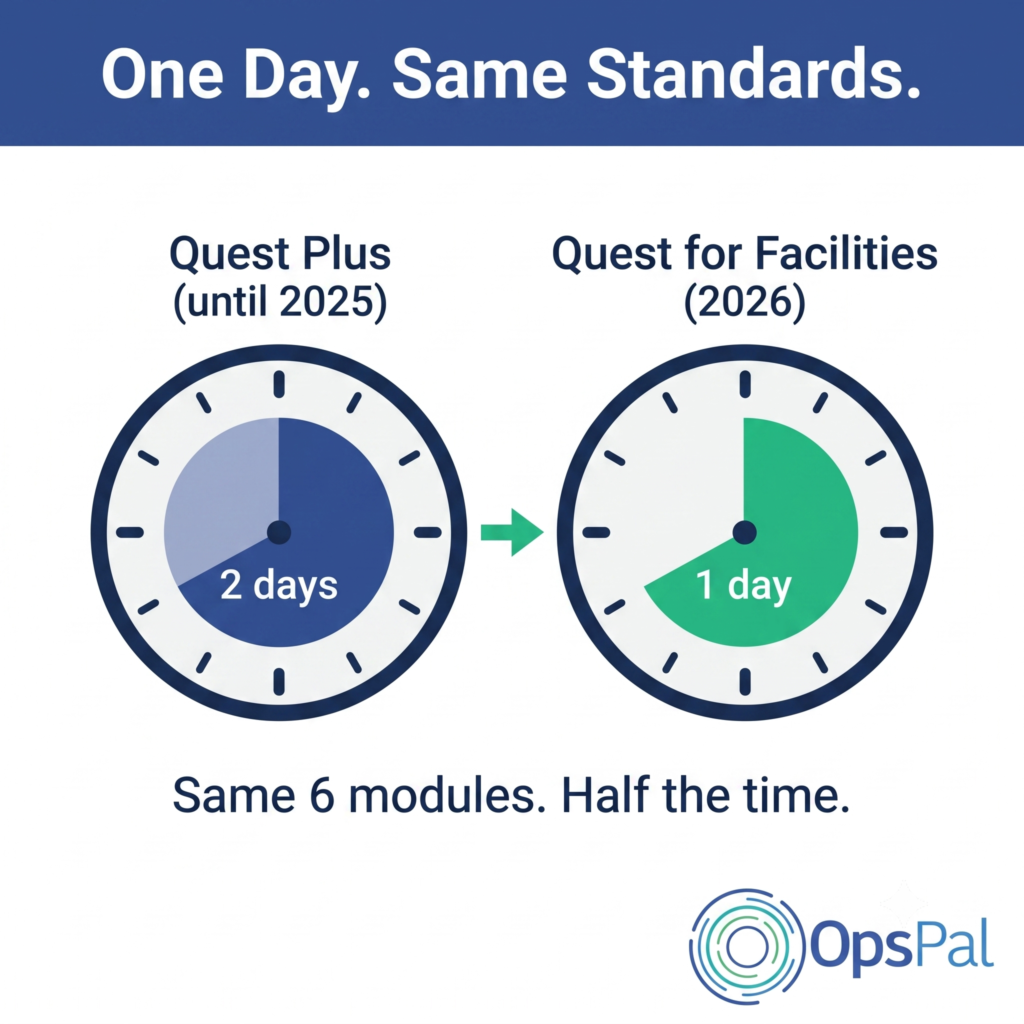
Under the old Quest Plus format, you had two days on-site. A rocky Monday could be balanced out by a strong Tuesday — the assessor built a fuller picture, not just a snapshot. From 1 January 2026, that safety net is gone. Right Directions, who run Quest on behalf of Sport England, has moved every facility onto a single-day Quest for Facilities assessment alongside a mystery visit. Same core standards. Same mystery visit. Half the time to prove you’re meeting them.
That’s the paradox nobody’s talking about: a shorter assessment makes daily standards matter more, not less. One day means whatever the assessor sees on that day is effectively the whole verdict.
What’s Actually Changing With Quest Accreditation in 2026
The headline shifts, confirmed by Right Directions:
- Quest Plus — the two-day format — is gone. Every facility now sits a one-day Quest for Facilities assessment plus a mystery visit, renewed every 12 months, at £1,295 plus VAT.
- You can still add external standards alongside it: Tackling Inequalities in Leisure (£125+VAT), Exercise Referral (£200+VAT), Swim England Learn to Swim (£200+VAT) — each partly assessed on the day, with the rest completed online within two weeks.
- Quest Active Wellbeing is new for 2026, built for community development and wellbeing teams working beyond the four walls of a facility. From spring 2026, combine it with your Quest for Facilities result and you get a Quest Place Score — one number showing your full contribution to the area.
None of that changes what assessors are actually looking for: continuous improvement, empowering the team, driving participation, customer delivery, operational and environmental management. What’s changed is how long they’ve got to find it.
The Six-Week Scramble Doesn’t Work Anymore
You know the routine. Quest letter lands, six weeks out. Risk assessments get a dusting-off they haven’t had all year. Staff get drilled on standards they’ll have forgotten by March. Evidence portfolios get built showing three weeks of best behaviour dressed up as normal practice.
That approach was already shaky under the two-day format — a facility running on borrowed polish shows the cracks by lunchtime on day two. Under one day, there’s no day two. There’s no time for the assessor to see you recover from a bad start. What they see in those few hours is what goes in the report.
Why Doesn’t Quest Turn Up Unannounced?
Here’s my honest view: I don’t think facilities should ever know when their assessment is. Give an assessor a completely unannounced visit and they see the real business, not the version that’s had six weeks to get camera-ready.
It’s not a wild idea. The Food Hygiene Rating Scheme already works that way — environmental health officers turn up with no warning, specifically so they see an ordinary day rather than a staged one. Nobody in hospitality gets six weeks’ notice to deep-clean before their food hygiene inspection. That’s rather the point of it.
Quest can’t run that way, and there’s a fair, practical reason: you need site access booked and the right people on shift (or maybe the site should always have a manager in who understands what’s going on), and a mystery visit alone can’t cover every module. But there’s an honest tension worth naming too — score every leisure centre unannounced tomorrow and average scores would drop hard across the board. At that point you’re not really testing facilities anymore. You’re testing whether the scheme itself holds up once the notice period’s gone. That’s not a knock on Quest — it’s just what happens to any assessment that has to give warning.
Which is exactly the case for running things this way daily rather than for six weeks a year. OpsPal doesn’t know what day it is. It’s on 365, not on notice — the dashboard looks the same on a random Tuesday in July as it does on assessment day, because it’s built off a year of actual operations, not a run-up. An environmental health officer could turn up unannounced tomorrow and nothing about your evidence trail would need to change either.
Run It Well Daily, and Quest Accreditation Looks After Itself
This is where OpsPal changes the maths. Instead of building evidence for Quest once every six weeks, your daily operations become the evidence.
Risk assessments get reviewed on a rolling cycle with automatic amber/red flags, not a scramble the week before assessment. Daily task records — pool plant checks, cleaning schedules, opening routines — are logged as they happen, with a timestamped trail an assessor can pull up in seconds rather than a filing cabinet someone has to dig through. Training Matrix keeps qualification expiry visible three ways — individually, by site, and across the organisation — so “is everyone still qualified” is a five-second check, not a phone-round two days before assessment. When a duty manager finishes a shift, the evidence is already sitting there. Nobody has to go and build it.
That’s the whole shift: from “get ready for Quest” to “Quest just watches what you already do.” OpsPal’s accreditation software was built around exactly that — pulling the audit trail together automatically so assessment week looks like every other week.
What This Actually Looks Like
Watford Leisure Centre Woodside is one of five centres in England holding Quest Outstanding, and has held it for three consecutive years running. Assessors cited tackling inequalities, environmental management, swimming lessons, engaging older people, and customer journey as standout areas. That’s not a facility that peaks for assessment week — that’s a facility running to that standard every week, which the assessor then confirms.
DLR Leisure in Dublin applied the same principle directly through OpsPal. Before, three key staff were spending 15 hours a week each, for four weeks, ahead of every accreditation assessment — 180 hours of preparation time pulled off day-to-day operations. After OpsPal, that dropped to zero additional hours. As Niall Cull put it, the systems they’d built in-house to cope “became redundant overnight” once OpsPal took over. The external assessor’s verdict: “Everybody should be using OpsPal if they want to know what is going on in their business.” (Read the full DLR Leisure case study)
Monday Morning Action
Pull up your last Quest report. Find the module that scored lowest. Then ask yourself: is there a live record right now showing that standard being met today — not a document from six weeks ago? If the honest answer’s no, that’s where continuous compliance starts.
Quest accreditation in 2026 rewards facilities that don’t need to prepare. Book a demo to see how OpsPal turns your daily operations into a Quest-ready record, without the six-week scramble.
Sources
- Types of Assessment, Quest / Right Directions, 2026
- About Quest, Quest / Right Directions, 2026
- Woodside Leisure Centre achieves ‘outstanding’ rating in national Quest assessment, Watford Borough Council, 2024
- Food Hygiene Rating Scheme, Food Standards Agency, 2025
- The Food Hygiene Rating Scheme Explained: Answering your FAQs, High Speed Training, 2025
- Leisure Accreditation Software case study: DLR Leisure, OpsPal