Your Staffing Crisis Isn’t the Vacancies — It’s Your Leisure Centre Induction Process
Picture a mid-sized trust — three sites, a couple of hundred staff, decent reputation locally. Every time someone leaves, whoever’s on duty pulls together an induction from bits of paper, old training sheets, and whatever the last person remembers being told. Nobody signs to say they understood the pool plant procedure. Nobody flags that the fire evacuation training is six months out of date for the new starter on nights.
It’s not neglect — everyone’s just too busy keeping the doors open to notice the gaps stacking up. Then a Quest assessor asks to see training records for the last three starters, and the room goes quiet.
That’s not a one-off. That’s the leisure centre induction process at most trusts I’ve worked with — held together by whoever happens to be on shift and however much they can remember.
The Real Cost Isn’t the Vacancy
Everyone’s fighting the same battle right now — better pay, flexible shifts, apprenticeships, whatever it takes to get bodies through the door. Fair enough. CIMSPA’s own workforce data shows 71,000 unique job postings across sport and leisure in 2022, up 47% on 2019 levels — and with 30% of the workforce aged 16 to 24 (three times the national average), you’re not recruiting once, you’re recruiting on a loop.
But here’s what nobody’s saying out loud in the boardroom: fixing recruitment doesn’t fix the actual problem. Bring in ten new lifeguards next month and you’ve got ten new sets of paperwork nobody can find, ten inductions built from memory, ten people signing off training they were never properly shown. The staffing crisis gets the headlines. The leisure centre induction process underneath it is the one quietly costing you money — and it’s the one you can fix this week, labour market or not.
Why It Breaks Every Time
A 2022 CIMSPA Employer Partner survey, reported in Health Club Management, found leisure shortages severe enough that the majority of operators surveyed had been forced to partially or fully close facilities as a result. Every one of those gaps gets filled eventually — but the process that welcomes the new starter rarely gets the same attention as the vacancy itself.
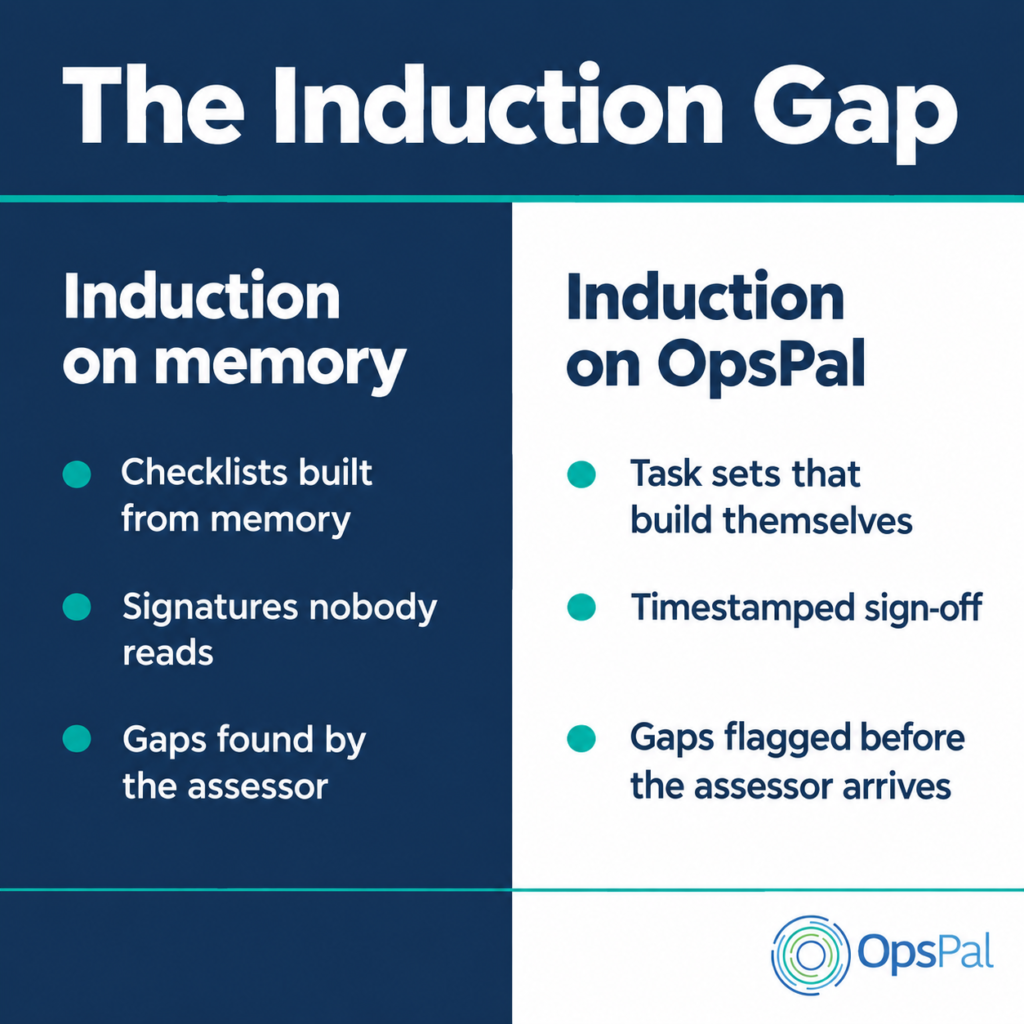
Here’s what actually happens on a Tuesday. A duty manager gets told someone starts tomorrow. They dig out last year’s induction checklist, which is missing the updated NOP from March. They print what they can find. The new starter signs a piece of paper to say they’ve “read and understood” seven documents in ninety minutes, half of which they skim. Three months later, when the assessor asks who signed off on manual handling training, the answer is a shrug and a filing cabinet.
Glad it was Quest asking and not HSE. Quest knocks your accreditation. HSE can shut the site.
None of that is anyone being lazy. It’s what happens when your induction process depends entirely on human memory and paper, and both run out at exactly the moment you need them most — when someone new is standing on reception on their first shift.
How OpsPal Fixes the Leisure Centre Induction Process
This is where visibility beats memory. OpsPal’s task management can auto-populate a full induction — pool plant walkthrough, NOP sign-off, fire evacuation, safeguarding basics — the moment a new starter is allocated to the right department. It’s built from what that role actually needs, not from what someone remembers to hand over.
Each task carries its own instructions, and staff have to sign to confirm they understand before they can mark it complete. That’s not a box-ticking exercise — it’s the difference between “I was shown the fire exits” and a timestamped record that proves it, sitting ready the next time an assessor asks.
The training matrix tracks qualifications and expiry at three levels — individual, site, and organisation — so a duty manager can see at a glance who’s current, who’s expiring within 90 days, and who’s overdue. No more discovering a gap when someone’s already on poolside.
And when someone leaves, OpsPal automatically transfers their outstanding tasks and problems to whoever picks up the role, while flagging every document and training gap the new person needs for that specific job. The handover that used to depend on a good memory now happens without anyone having to remember anything. We’ve written before about why software alone doesn’t fix onboarding — the human side still matters. What OpsPal does is make sure the paperwork side of your leisure centre induction process is never the reason a new starter is unprepared, or the reason an assessor finds a gap.
If you’re building or tightening up your wider health and safety and training compliance approach, this is usually where it starts.
Monday Morning Action
Pull the induction records for your last three new starters. Can you show, in under two minutes, exactly what they were trained on, when, and who signed it off? If the honest answer is “not without a phone call to the site,” that’s not a small thing. That’s where you start.
Sources: