The Operational Debt That’s Quietly Killing Leisure Trusts
Picture a Monday morning. Your senior manager walks in, checks the weekend paper logs, and finds three tasks that weren’t completed on Saturday night. They spend the next hour chasing down who was on shift, what happened, and whether there’s a record of it anywhere. There isn’t. That hour? It happens every week. In some leisure trusts, it happens every day. Multiply it across your sites, across your management team, across 52 weeks — and you’re looking at hundreds of hours a year that your organisation is paying for and getting nothing back from. Fusion Lifestyle just reminded the whole sector what happens when the margins run out.
In April 2026, Fusion Lifestyle — a leisure charity running 20 centres across the UK for 26 years — entered administration. Their statement cited rising operational costs, reduced government funding, and post-pandemic recovery challenges. All real. All brutal. But there’s a question that rarely gets asked in conversations like this one: how much of that operational cost was invisible waste? Not deliberate. Not negligent. Just the slow, compounding drain of running a complex leisure operation on systems that were never built to scale.
That’s what operational debt looks like. And right now, it’s sitting quietly in leisure trusts up and down the country.
What Operational Debt Actually Costs Leisure Trusts
The big costs are visible. Energy bills. Wage rises — the National Minimum Wage rose 6.7% to £12.21 per hour in April 2025, hitting a sector built on hourly-paid staff harder than almost any other. Reduced local authority funding. These land on the balance sheet and get discussed in board meetings.
The invisible costs don’t. They live in the gap between how your operation is supposed to run and how it actually runs at 9pm on a Saturday when the manager’s gone home.
Think about what happens when a risk assessment gets updated. In a paper-based system, someone prints it, puts it in the binder, and hopes the team reads it. Did they? You don’t know. If an HSE inspector arrives next week and asks which staff members have read the updated pool plant room risk assessment, what’s your answer? “We printed it” isn’t one.
Or think about task completion. Your closing checklist gets signed off every night — but who’s checking that the checks were actually done, not just ticked? In most leisure centres running on paper, the honest answer is nobody. Not until something goes wrong.
These aren’t hypothetical failures. They’re the daily reality of leisure centre operations across the UK, and they have a real cost — in management time, in compliance risk, and ultimately in the financial resilience of the organisation.
The Compounding Problem
Here’s why operational debt is dangerous: it doesn’t announce itself. It builds slowly, across dozens of small inefficiencies that each feel manageable on their own.
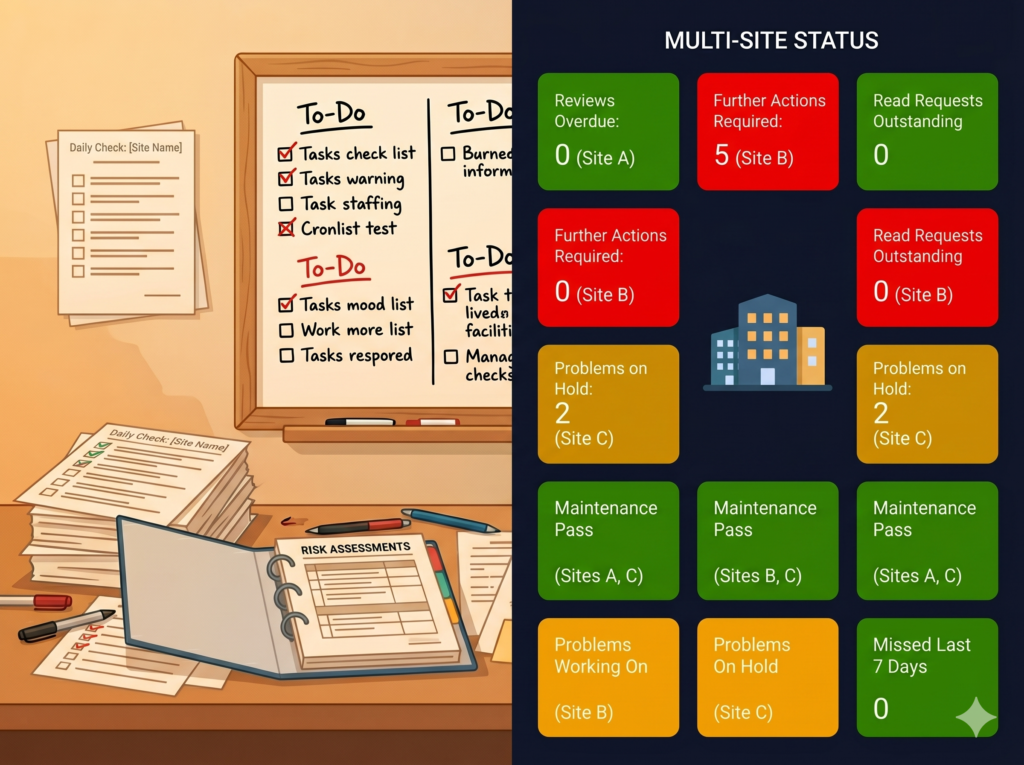
A duty manager spends 45 minutes on a handover that should take ten — because there’s no live system showing what’s outstanding, so they have to piece it together from paper logs and memory. A site manager drives across town to check whether a compliance task was completed — because there’s no dashboard showing it. A senior leader spends two hours preparing for an accreditation visit pulling together evidence from filing cabinets and spreadsheets — because nothing is stored centrally or audit-ready.
Each of those is a cost. Paid for in management time. Billed at whatever your duty managers, site managers, and senior leaders earn per hour. In a trust running multiple sites with stretched management teams, those hours add up fast.
And that’s before you factor in the compliance risk. A missed RIDDOR report. A risk assessment that hasn’t been reviewed in 14 months. A staff member who completed a task without reading the updated procedure first. These aren’t just operational failures — they’re financial liabilities. An HSE improvement notice, an insurance claim that doesn’t hold up, or a failed Quest accreditation visit all have a cost that lands squarely on the balance sheet.
Boards that focus only on visible costs are measuring half the problem.
What Thriving Trusts Do Differently
Not every leisure trust is struggling. BH Live — a leisure and entertainment charity operating across the south of England — is growing. They’re investing in their operation. And part of what sets thriving trusts apart from struggling ones is how seriously they treat operational infrastructure.
The trusts that are in good shape tend to share a few things. Their managers have live visibility of what’s happening across their sites — not a summary at the end of the week, but a real-time picture of tasks completed, problems logged, and compliance status. When something goes wrong at 9pm, the duty manager can see it, act on it, and record it — without waiting for Monday morning. When a senior leader needs evidence for an audit or accreditation visit, it’s there in seconds, not hours.
They’ve also moved away from the assumption that compliance is a cost to be minimised. The trusts that treat operational compliance as an asset — something that protects the organisation, demonstrates accountability, and reduces risk — are the ones building financial resilience. The ones still treating it as a burden to be managed on paper are carrying more exposure than their balance sheet shows.
There’s also something less tangible but just as important: staff confidence. When your team know exactly what’s expected of them, can see their responsibilities clearly, and have a system that supports them rather than leaving them guessing — they perform better. Especially on that Saturday night shift when no one senior is around.
The Operational Efficiency Question Boards Should Be Asking
If you’re a CEO or board member reading this, one question is worth putting on the agenda: what is operational inefficiency actually costing us?
Not a rough guess. A real number. How many management hours per week go on compliance admin, chasing updates, and pulling together evidence that should already be in one place? What’s the cost of a compliance failure — in management time, potential fines, and reputational damage — if something goes wrong? What would it mean for the organisation’s financial position if you could recover even a fraction of those hours and redirect them into service delivery?
If you’re an operational manager reading this, you probably already know the answer. The question is whether you have the language to take it upward.
Fusion Lifestyle’s administration is a warning, not just a news story. The sector is under genuine financial pressure, and the trusts that survive it will be the ones that treat operational efficiency as a financial discipline — not just a management preference.
What Good Looks Like
OpsPal is cloud-based digital operations software built specifically for UK leisure centres, trusts, and multi-site facilities. It replaces paper logs, spreadsheets, and filing cabinet risk assessments with a live operations dashboard — giving managers real-time visibility of task completion, compliance status, and staff training across every site.
When a risk assessment is updated, staff get notified and their acknowledgement is tracked. When a task is overdue, it surfaces automatically — no chasing required. When an inspector arrives or an accreditation visit is due, the audit trail is there, complete and timestamped. And when someone leaves, their tasks and problems transfer automatically, so nothing falls through the gap.
56 UK leisure organisations use OpsPal across 244 sites. Over 1.9 million tasks have been completed on the platform. That’s not a marketing number — it’s what operational discipline at scale actually looks like.
If you want to understand what that means for your trust’s operational costs — and what the conversation looks like — start the conversation with us at opspal.co.uk.
Sources
- National Minimum Wage Rates, UK Government, April 2025 — https://www.gov.uk/national-minimum-wage-rates
- Spotlight: UK Leisure Market 2026, Savills Research, March 2026 — https://www.savills.co.uk/research_articles/229130/382466-0
- Fusion Lifestyle enters administration, various UK regional press, April 2026
- HSE Leisure Activities guidance — https://www.hse.gov.uk/entertainment/leisure/index.htm
- RIDDOR 2013, HSE — https://www.hse.gov.uk/riddor/
- Quest National Benchmarking Service — https://www.questnbs.org/
- OpsPal platform data, March 2026 — https://opspal.co.uk