Local Government Reorganisation Is Coming. Here’s How to Get Your Leisure Operations Ready.
By Craig Campbell | OpsPal
There’s a moment in every major reorganisation when you realise that someone sorts out the technical stuff — the legal structures, the finance models, the governance frameworks. Lawyers, accountants, and consultants rally around it. Everyone has an opinion.
But nobody is talking about the people on the ground running leisure centres on a Tuesday morning when the management team hasn’t been confirmed yet, the new logo hasn’t been approved, and staff aren’t sure who their line manager is.
That’s the bit that keeps me up at night. And if you’re a leisure leader in a council or trust caught up in Local Government Reorganisation (LGR), I’d bet it’s the bit keeping you up too.
This blog isn’t about the politics. It’s about the opportunity – and how to make sure your leisure operation comes out of the other side stronger, not scrambling.
Why Leisure Gets Left Behind in LGR
Local Government Reorganisation is, by its nature, an administrative exercise. Structures merge. Teams consolidate. Boundaries redraw. The focus is overwhelmingly on statutory services — highways, planning, social care, waste.
Leisure sits in an awkward place. It’s often considered discretionary. It may be managed in-house, or through a trust, or through a mix of both across the authorities that are merging. The result is that leisure leaders are frequently handed the organisational outcome and told to make it work — with limited resources, under significant time pressure, and with the expectation that “operations will continue as normal”.
Normal, of course, is the last thing they are.
Staff are anxious. Systems don’t align. Procedures written for one way of working don’t fit another. Risk assessments sit in someone’s desk drawer — or worse, are scattered across SharePoint folders that the other authority can’t access. Nobody can tell at a glance whether compliance is current across all sites.
This situation is where organisations get caught out. Not intentionally. But a lack of operational infrastructure becomes visible rapidly when you’re trying to merge two or more leisure estates into one coherent service.
The Opportunity Nobody Is Talking About
Here’s the thing: LGR — for all its stress — is a genuine opportunity to build something better.
Most leisure operations, if we’re honest, are running on a patchwork of Word documents, spreadsheets, paper-based checklists, and tribal knowledge. They work — up to a point — because the same people are doing the same jobs in the same building every day. But ask those systems to stretch across merged organisations, multiple management teams, and sites that have never shared a compliance framework before? They crack.
LGR forces the question that should have been asked anyway: How do we actually run this operation consistently, across every site, regardless of who’s on duty?
The organisations that answer that question well — and answer it now, not after the merger is complete — will emerge from LGR with a genuinely stronger operational platform. Those that don’t will spend the next two years firefighting.
The difference between those two outcomes isn’t budget. It’s infrastructure.
What “Operational Infrastructure” Actually Means
I’ve spent over 30 years working in leisure operations — every department, every shift pattern, every type of facility. The organisations that run well aren’t necessarily the ones with the biggest budgets or the most senior leadership. They’re the ones where every member of staff knows what they need to do, when they need to do it, and how to do it correctly – regardless of whether the manager is in the building.
That’s operational infrastructure. And in a post-LGR world, it needs to work across sites you’ve never run before, for staff you’ve never managed, under a compliance framework you’re still building.
Three things make that possible:
1. A single source of operational truth Risk assessments, procedures, checksheets — all of it needs to live in one place, accessible to everyone who needs it, with a clear version history. If you can’t tell whether the risk assessment your team in the newly merged facility is working from is current, that’s a problem. If you can’t demonstrate to a regulator that staff across all your sites have read and acknowledged the procedures relevant to their role, that’s a bigger one.
2. Live visibility across the whole estate You cannot manage what you can’t see. In a merged leisure operation, senior leaders need to be able to see compliance status, outstanding tasks, and problem management across every site — without having to ring around, email managers, or wait for a weekly report. Decisions need to be made in real time. The dashboard needs to reflect what’s actually happening, not what happened last Friday.
3. Consistent delivery regardless of who’s on duty This is the hardest one. Operational consistency isn’t about policy documents. It’s about whether the staff member covering a shift at a site they’ve never worked at before knows exactly what’s expected of them — and has the tools to deliver it. That means task management that’s clear, training records that are visible to the manager making the assignment, and procedures that are a click away rather than buried in a folder nobody’s updated since 2019.

How OpsPal Supports the LGR Transition
OpsPal is a cloud-based digital operations management platform built specifically for leisure facilities. It replaces paper-based compliance systems with live dashboards, digital task management, training tracking, and real-time operational visibility — across one site or twenty.
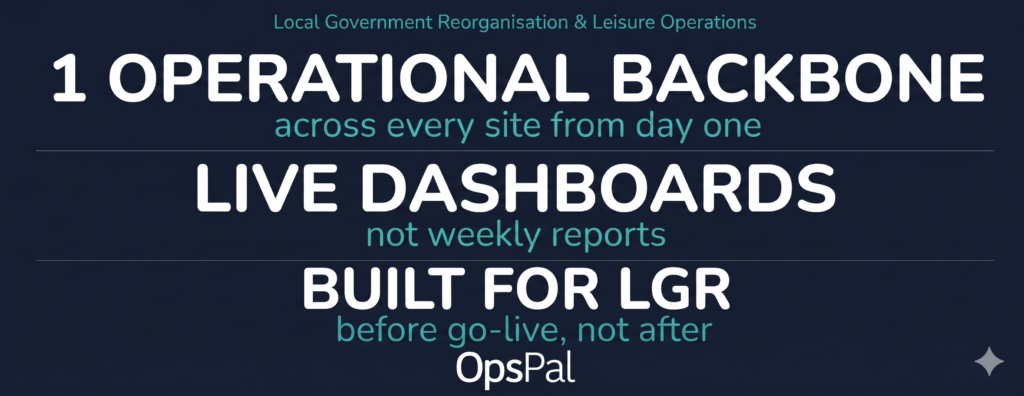
For organisations navigating LGR, it does something specific that matters enormously in a merger context: it gives you a single operational backbone for the whole merged estate from day one.
Here’s what that looks like in practice:
Multi-site from the ground up. OpsPal’s organisation-level dashboard gives senior leaders a high-level compliance status across every site. Drill down to site level in seconds and you see who’s completed what, what’s outstanding, and where problems have been logged. You’re not waiting for a manager to send you a report — you can see it live.
One set of procedures, consistently delivered. Using OpsPal’s corporate site function, you can create a procedure or update a risk assessment once and deploy it across every location immediately. All sites receive the updated version, staff receive an in-app notification, and the system tracks who has read and acknowledged the update. No more wondering whether the right version of a document has reached the right team.
Task management that travels with the team. Whether staff are working across newly merged facilities or covering absent colleagues, OpsPal’s task management ensures the right tasks are assigned, clearly explained, and tracked to completion. Every task includes an instruction area — staff must acknowledge the training expectations before marking it complete. That’s not a small thing when you’re onboarding teams who are new to your operational standards.
Training matrix visibility across the estate. One of the most common issues in an LGR merger is understanding exactly what qualifications your inherited workforce holds — and where the gaps are. OpsPal’s training matrix tracks this at individual, site, and organisation level, with colour-coded expiry indicators that flag what’s current, what’s expiring, and what’s already lapsed. Managers see their team’s competency status when making assignments. Senior leaders see patterns across the whole operation.
Problem management with accountability built in. When something goes wrong — equipment issues, hazards, maintenance flags — OpsPal’s problem management function logs it, assigns it, and tracks it to resolution. If a deadline is missed, the system flags it visually and sends a reminder. Nothing falls through the cracks because it was logged on a site you’re not physically visiting this week.
Microsoft integration for the way councils and trusts actually work. OpsPal integrates with Microsoft Entra SSO — which means staff can log in with their existing Microsoft 365 credentials. For organisations going through IT consolidation as part of LGR, that’s one less system to manage separately. Multi-Factor Authentication is available for added security. Sensitive data such as accident reports can be handled through Microsoft Forms integration.
The Window Is Now — Not After Go-Live
The temptation in any reorganisation is to wait until the dust settles before tackling operational systems. It’s understandable. There’s so much else to deal with.
But operational infrastructure is one of the few things you can get ahead of. And the organisations that do — that build their compliance framework, embed their procedures, and get their task management running before the formal merger completes — give themselves something valuable: operational confidence on day one.
They’re not scrambling to find out whether sites are compliant. They’re not chasing managers for updates. They’re not trying to retrospectively prove to a regulator that standards were maintained through the transition. They’ve got a live dashboard that tells them exactly what’s happening, across every site, right now.
That’s not just operationally sensible. In the context of LGR, where scrutiny of leisure services often increases rather than decreases during a transition period, it’s a genuine risk management position.
Ready to Talk?
If you’re a leisure leader inside a council or trust preparing for LGR, I’d genuinely like to talk. Not a sales pitch. A conversation about what your operation looks like, what the merger creates in terms of operational challenge, and whether OpsPal is the right fit to help you get ahead of it.
I’ve worked through enough reorganisations to know that the ones who struggle aren’t the ones who lacked ambition — they’re the ones who underestimated how hard it is to hold operational standards together when the structure is changing underneath them.
You don’t have to be one of those.
Craig Campbell is the founder of OpsPal, a digital operations management platform for UK leisure facilities, and Director of OpsExcellence, a free best practice community for leisure professionals. He has over 30 years of operational experience across the UK leisure sector.