Why Your Digital Transformation Is Failing Your Frontline Staff
Your booking system is cloud-based. Your member app has five-star reviews. Your access control integrates with everything.
And yet your duty manager is currently on their third phone call trying to find out if the pool plant room checks were completed this morning.
This is what incomplete digital transformation looks like.
The Expensive Illusion of “Going Digital”
UK councils, universities, and leisure trusts spend between £50,000 and £500,000 on digital transformation. The money goes to customer relationship management systems, online booking platforms, mobile apps, digital signage, and access control systems.
These are genuine improvements. They make promises to customers about seamless service, instant responses, and modern experiences.
But here’s the problem: your frontline staff can’t actually deliver on those promises because they’re still operating with paper checklists, email chains, and verbal handovers.
Your digital transformation stopped at the customer interface. The operations that actually deliver the service? Still running on systems designed for the 1990s.
What Failure Looks Like in Real Time
The Maintenance Black Hole
A member books a swimming session through your award-winning app at 6:00am. Arrives at 6:30am. Your digital access control lets them through. They find the pool closed.
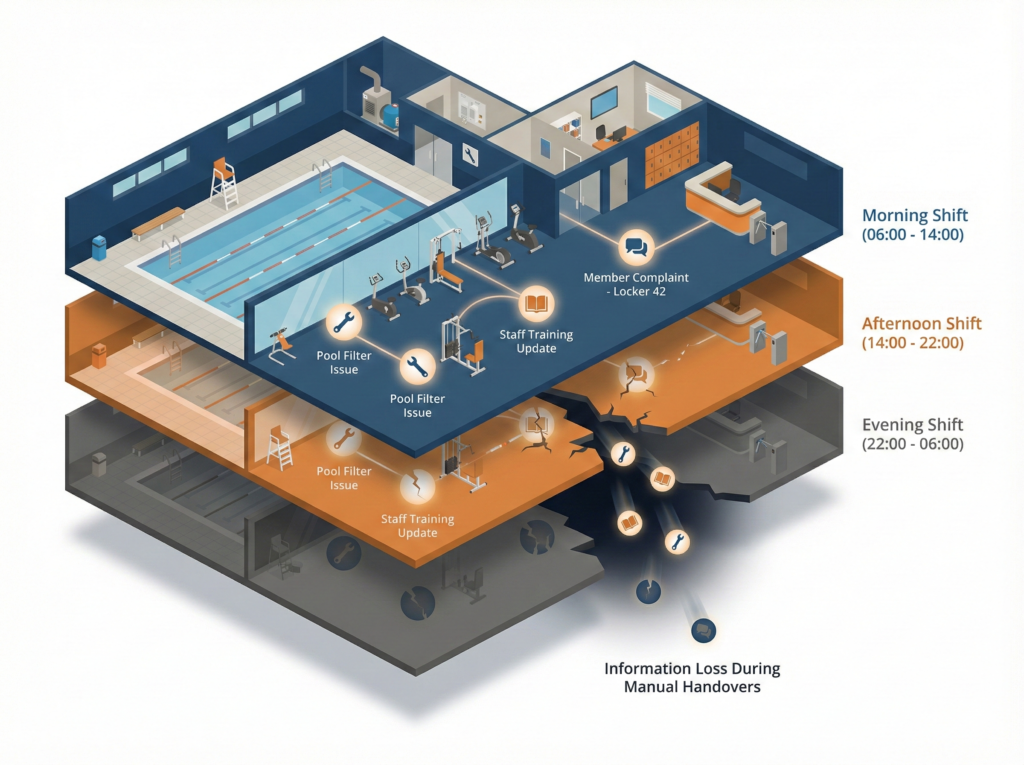
What happened? The plant room technician noted a water quality issue in the paper logbook last night. The night duty manager saw it during their walk-through. Handover was rushed—three staff called in sick, there was spillage in the gym, and conversation happened while walking between incidents. The morning duty manager checked emails and the booking system but won’t see that paper log until their 8:00am walk-through.
Your booking system is digital. Your operations are not. The customer experience fails at the gap between them.
The Conflicting Procedures Crisis
Your deputy manager faces a suspected safeguarding issue. They open the shared drive, find the safeguarding procedure, and follow it precisely. Three hours later, your head of operations calls, concerned. “Why didn’t you contact the designated safeguarding lead immediately?”
The deputy manager followed procedure—the one they found. Version 4 from 2023. The updated version from six months ago requires different steps. But the shared drive has seven versions across different folders.
You’ve invested in digital customer systems. Your procedures are still trapped in folder structures where version control means hoping people find the right file.
The Invisible Problem
Monday 3pm: Member reports treadmill noise. Reception emails duty manager. Tuesday 10am: Different member reports same treadmill. Different duty manager, different inbox, no visibility of Monday’s report. Tuesday 3pm: Treadmill seizes. Member trips. Incident report filed.
Wednesday morning: The operations director asks why a twice-reported treadmill wasn’t taken out of service. Answer: Because problem tracking happens through email, verbal handovers, and individual memories.
Your digital transformation tracks customer complaints brilliantly. It doesn’t track operational problems from report to resolution.
The Real Cost: £60,000+ Annually
Duty Manager Time: £30,000 Four hours per week hunting for information across 10 sites = 2,080 hours annually at £15/hour = £31,200 wasted on information archaeology.
4 x Area Manager Reporting: £25,000+ Half a day weekly requesting updates from each centre instead of seeing real-time dashboards = 208 hours per manager annually at £30/hour = £24,960 spent on manual data aggregation.
Problem Escalation: £15,000+ per incident Minor maintenance becomes equipment failure. Training gaps become incidents. Procedure confusion becomes non-compliance. One escalated incident costs £15,000+. Three per year = £45,000 in preventable costs.
Total annual cost of partial transformation: £60,000+ in operational inefficiency alone.
Why Transformation Budgets Get This Wrong
Board-level budget allocation typically looks like this:
- 70% customer experience systems
- 20% infrastructure
- 10% “other”
- 0% operational excellence
Why? Because customer experience is visible. Board members see the app, use the booking system, and understand the value immediately. Operations are invisible. They don’t see duty managers hunting through email chains or watch shift handovers where critical information gets lost.
Result: You’ve digitised the shop window while leaving the warehouse running on clipboard and hope.
What Complete Transformation Actually Requires
Real transformation that delivers ROI requires operational excellence foundations that enable frontline staff to deliver on promises your customer systems make.
Real-Time Operational Visibility When your area manager opens operational dashboards, they see which centres have incomplete critical tasks right now, what problems are logged and who’s addressing them, training status across the team, and maintenance schedules. No email chains. No phone calls. Live operational command and control.
Centralised, Version-Controlled Procedures Single source of truth where procedure updates push to every device instantly. When you update the fire evacuation procedure at head office, every staff member’s device reflects the change immediately. No more than seven versions across folders.
Systematic Problem Tracking Monday 3pm: Treadmill noise → Problem logged, assigned to maintenance, duty manager notified. Monday 5pm: Shift change → Incoming manager sees open problem, status, and action taken. The system won’t allow the treadmill to be marked “available” until the problem is closed. The problem can’t fall through gaps.
Task Management That Prevents Pool Plant Room Checks Due at 6:00am → Assigned to Qualified Staff → Reminder if Not Completed by 6:30am → Escalated to Duty Manager if Outstanding at 7:00am → Area Manager Alerted if Pattern Develops. Prevention, not reaction.
The Integration That Makes Everything Work
When operational excellence systems integrate with customer-facing transformation:
Plant room technician notes issue → Logs in system → Automatically visible to morning duty manager → System blocks online bookings → Members receive automated notification → Maintenance completes work → Problem closed → Bookings reopen.
The customer never experiences the failure because operational systems prevented it.
Multi-site leisure operators spending £300k on customer systems while leaving operations on paper are wasting £200k+ of that investment. The customer systems can’t deliver ROI when operations can’t keep up.
The Choice Your Board Needs to Make
Option 1: Keep allocating transformation budgets to customer-facing systems. Hope frontline staff “make it work” with email and personal heroics. Wonder why transformation ROI never materialises.
Option 2: Recognise that digital transformation means empowering frontline staff to deliver on promises customer systems make. Allocate the transformation budget to operational excellence as foundation infrastructure, not as an afterthought.
One facilities manager described it: “We spent £200k on booking systems and still had complaints. We spent £8k on operations management, and the booking systems finally delivered ROI. The technology was never the problem—our operational capability was.”
Their approach shows how operational excellence transforms not just operations but the entire customer experience your digital systems promise.
Your Frontline Staff Are Ready
They don’t need motivational speeches or team-building exercises. They need systems that let them do their jobs properly.
Your duty managers want critical information instantly, not through phone calls. Your staff want current procedures on their devices, not outdated folders. Your area managers want operational visibility, not email threads requesting updates.
They’re already working incredibly hard to deliver service despite your systems. Imagine what they could achieve with systems that actually helped them.
Your digital transformation will fail your frontline staff until you give them the operational excellence foundations they need to deliver on the promises your customer systems are making.
The technology exists. The capability is proven. The ROI is documented.
The question is whether your 2026 transformation budget will finally include the people who actually deliver your service.
Sources
- Digital transformation in government: addressing the barriers to efficiency, Committee of Public Accounts, 2023, https://publications.parliament.uk/pa/cm5803/cmselect/cmpubacc/1229/report.html
- Taking digital transformation forward in your organisation, Jisc, 2024, https://www.jisc.ac.uk/taking-digital-transformation-forward-in
- UK Government Pioneers Strategic Method to Digital Sourcing, Procurement Magazine, March 2025, https://procurementmag.com/procurement-strategy/uk-government-develop-digital-sourcing-strategy
- Digital transformation in the management of higher education institutions, ScienceDirect, May 2025, https://www.sciencedirect.com/science/article/pii/S266618882500259X
- How to Create a Digital Transformation Budget, Weavix, August 2025, https://weavix.com/blogs/digital-transformation-budget/
- The Cost of Digital Transformation in 2026, Whatfix, 2026, https://whatfix.com/blog/digital-transformation-cost/
Need help completing your digital transformation with operational excellence systems that empower your frontline staff? Book a consultation to discover how operations management software transforms not just operations but the entire service delivery your digital investments promise.