Leisure Centre Visibility: Why a Big Operator Missed the Same Warning Twice
When the HSE release landed about Parkwood Community Leisure Ltd, I didn’t feel shocked. I felt sick, then I felt something closer to recognition. Parkwood isn’t a single struggling site — it’s one of the biggest leisure operators in the country, running centres up and down the UK. And the failure at the heart of the case wasn’t some obscure engineering fault nobody could have caught. A hazard was reported once, believed dealt with, and never checked again — right up until it killed a customer. That exact gap is the reason OpsPal exists.
I know that gap first-hand. When I was running sites across LA Fitness, I’d ring a centre and ask how things were. “All fine.” I’d email for the monthly update. “All good, nothing to report.” Then I’d turn up unannounced, and it was very rarely fine. Not because anyone was lying to me. Because nobody at head office had any way of actually seeing what was happening day to day. We were making decisions on phone calls and hope. That’s not a management problem. That’s a leisure centre visibility problem, and most operators still have it.
Here’s the bit that should worry you more: it’s not just missed cleaning or a scruffy changing room that slips through that gap. Sometimes it’s a fault that’s been reported once, believed to be “in hand,” and never checked again. And sometimes the person who finds out it wasn’t fixed isn’t head office. It’s a customer.
When Nobody Sees a Known Fault, Someone Pays for It
In June 2026, Parkwood was fined £60,000 plus £40,000 costs after Albert Xhediku, 34, was electrocuted at Mountbatten Leisure Centre in Portsmouth. He’d been playing five-a-side football, went to retrieve the ball from over a fence, and came into contact with a floodlight carrying a fatal current. HSE’s investigation found worn, faulty wiring that had been there for years, un-inspected and unmaintained, in breach of the maintenance duties set out in the Electricity at Work Regulations 1989.
Here’s the detail that should stop you cold: a month before Albert died, an off-duty police officer had already been shocked by the same floodlight. It was reported. And then nothing happened. Parkwood pleaded guilty to breaching Section 3(1) of the Health and Safety at Work etc. Act 1974, the duty owed to members of the public, not just employees.
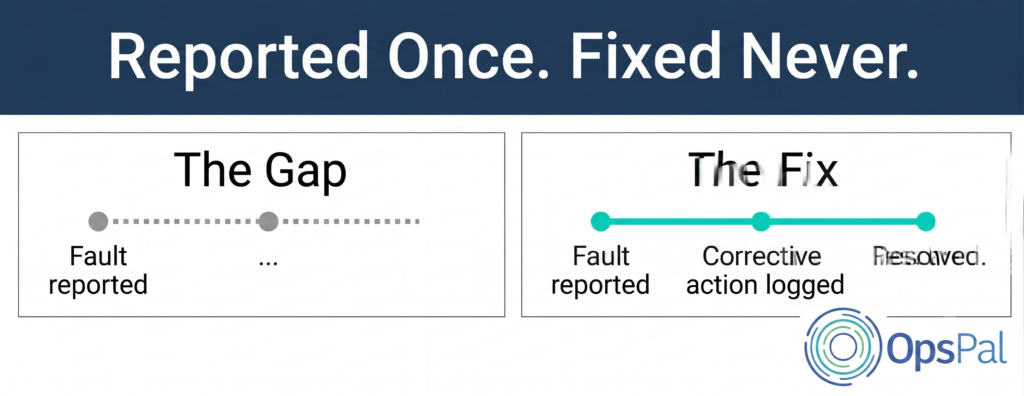
This wasn’t a case of nobody knowing. Somebody knew. The fault was flagged once, at site level, and whatever happened to that report between the person who raised it and the person who could have fixed it, it never turned into a closed-out job with a deadline anyone was accountable for. It sat somewhere, in someone’s memory or a diary nobody else read, for a month. Then longer than that.
Why Leisure Centre Visibility Can’t Run on Self-Reporting
A phone call telling you it’s fine is an opinion. An email saying nothing to flag is an opinion. Neither is evidence, and neither survives a busy Saturday shift, a change of duty manager, or three weeks passing since someone last thought about it.
The uncomfortable truth is that most operators are still running exactly the same system I was running at LA Fitness — one where the only way head office finds out something’s wrong is if a site manager remembers to say so, worded carefully enough to sound urgent but not so urgent it looks like their fault. No training course fixes that. What fixes it is redesigning how the information travels in the first place, which is what real visibility across a leisure centre actually has to mean: something you can check, not something you’re told.
Picture it from the other end. A duty manager mentions a dodgy floodlight to whoever’s on the desk at handover. It’s a Tuesday, they’re rushed off their feet, and it comes out as “someone needs to look at that at some point.” Three managers and two months later, nobody remembers whose job it was. Nobody was careless on purpose. A report with nowhere permanent to live just disappears, and that’s the default, not the exception.
How OpsPal Closes the Loop
OpsPal’s Operations Dashboards exist for exactly this gap. Instead of asking a site how it’s doing, you look. Organisation-level dashboards show risk assessment and task status across every site in real time, green for up to date, amber for due within 30 days, red for overdue, so head office can see where attention is needed without ringing round for reassurance.
When a fault is reported, it goes into Problem Management, not a WhatsApp message or a verbal aside at handover. Photo evidence, an assignee, a status — and before anything else, one question you have to answer to log it at all: what immediate corrective action have you taken? Not the long-term fix. The right-now one. In this case, that’s switching the floodlight off and keeping people away from it, not just noting the fault for someone to look at “when they get a chance.” If the person responsible then sets a completion date for the permanent fix and misses it, it doesn’t quietly disappear, it moves back to action required and shows up flagged for the manager above them. Every step from report to resolution is logged, so if anyone ever needs to show what happened and when, it’s there, not reconstructed from memory two years later in a courtroom.
The University of Stirling’s Sport team made a version of this exact shift, moving from scattered, site-level record keeping to a single system leadership could actually see into, rather than relying on individual managers to flag what mattered.
None of this replaces a competent electrician or a proper inspection regime. OpsPal doesn’t test your wiring. What it does is make sure a reported fault can’t quietly become an assumed one, and that the gap between “someone mentioned it” and “someone fixed it” has a name, a date, and a person attached to it throughout.
Monday Morning Action: Next time someone tells you a site is all fine, don’t take the call as the answer. Ask to see it. If you can’t get proof of current status in under a minute — not a promise, proof — that’s your leisure centre visibility gap. It’s exactly the gap we built OpsPal to close, and it’s worth finding before HSE finds it for you.
Sources
- Leisure firm fined after death of footballer electrocuted by floodlight, HSE Media Centre, 17 June 2026, https://press.hse.gov.uk/2026/06/17/leisure-firm-fined-after-death-of-footballer-electrocuted-by-floodlight/
- The Electricity at Work Regulations 1989 (HSR25), Health and Safety Executive, updated 2025, https://www.hse.gov.uk/pubns/books/hsr25.htm