Before You Tell Another Leisure Centre to Get Their House in Order — Is Yours?
There’s a particular kind of expert in the leisure industry. They’ve done the job, they know their stuff, and they’ve built a business helping others get better at it. Training companies, management consultants, kit suppliers, governing bodies, pool plant engineers, event organisers — the people the industry turns to when it needs to raise its standards. Brilliant at what they do. And occasionally, just occasionally, running their own shop on a wing and a prayer and hoping nobody looks too closely.
This isn’t a dig. It’s a genuine question. Because the same compliance obligations that apply to the leisure centres you serve also apply to you.
Same HSE. Same Health and Safety at Work Act. Same DSE regulations for office-based staff. Same requirement to have documented procedures, reviewed risk assessments, trained staff, and evidence that all of it actually happened. The postcode on your invoice doesn’t change any of that.
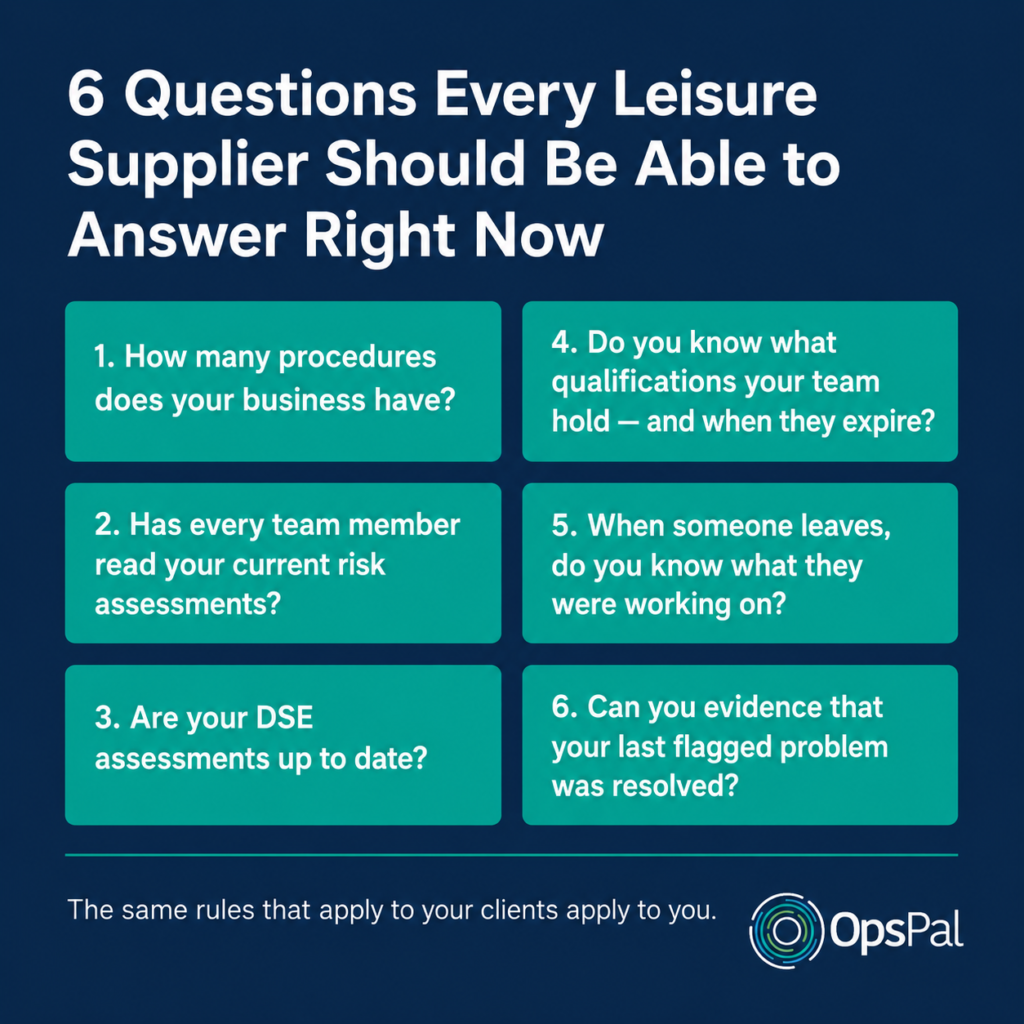
So — can you answer these questions about your own business right now?
The Questions Every Leisure Supplier Should Be Able to Answer
How many procedures does your business have?
Not a rough guess. An actual number. And when were they last reviewed? If your answer is somewhere between “a few” and “loads,” you already know what that means.
Has every member of your team read the current version of your risk assessments?
Not the version from 2021. The current one. And can you prove it? If an HSE inspector walked into your office today and asked for evidence that your staff have read and acknowledged your risk assessments, what would you hand them?
Are your DSE assessments up to date?
If you have people working at screens — in an office, at home, travelling between client sites with a laptop — DSE assessments are a legal requirement. Not a nice-to-have. The regulations haven’t changed just because your clients happen to work poolside.
Do you know what qualifications your team hold, and when they expire?
A training company that can’t produce a current training matrix for its own staff. A management consultant whose first aid certificates lapsed eighteen months ago. A kit supplier whose engineer hasn’t completed a mandatory manufacturer certification renewal. These aren’t hypothetical — they happen, quietly, in businesses that are too busy looking outward to look inward.
When someone leaves your business, do you actually know what they were working on?
This one stings a little, because most directors don’t find out what they’ve lost until three weeks after someone walks out the door. Tasks half-finished. Problems being tracked that nobody else knew about. Client commitments sitting in someone’s head and nowhere else. The knowledge gap left by a good person leaving is rarely discovered immediately — it surfaces slowly, at the worst possible moment.
The last problem that was flagged in your business — was it resolved, and can you prove it?
Or did it sit in an email chain, get mentioned at a team meeting, and then quietly disappear because nobody owned it?
Why This Happens — And Why It’s Not Laziness
The businesses that supply into the leisure industry aren’t cutting corners because they don’t care. They’re doing it because they’re busy, they’re focused on delivering for their clients, and frankly — nobody has ever asked them these questions. Their clients haven’t asked. Their industry bodies haven’t insisted. The assumption, often unspoken, is that the compliance burden sits with the facility. Not the supplier.
That assumption is wrong. And in an industry that’s worked incredibly hard to raise its operational standards — through Quest, through ukactive TAS, through CIMSPA professional frameworks — it’s a gap worth closing.
If CIMSPA is defining what professional standards look like for the sector, and ukactive is setting the benchmark for operational excellence, it’s worth asking whether the organisations doing that work hold themselves to the same standard. Not as a challenge — as an invitation. If the standard-setters lead by example, the rest of the supply chain follows.
OpsPal Isn’t Just for Leisure Centres
This is probably the bit where you think: “Yes, but systems like OpsPal are built for leisure facilities, not businesses like mine.”
Fair assumption. Wrong conclusion.
OpsPal works for any business that has staff, tasks, compliance obligations, and standards to maintain. And here’s the important bit — it doesn’t replace your CRM. Your CRM manages your clients, your pipeline, your customer relationships. That’s its job and it does it well. OpsPal manages something completely different: what your business does for itself. Your people. Your assets. Your compliance. Two different problems. Two different tools. No overlap.
Take a leisure equipment supplier. Their CRM logs every customer call, every quote, every service visit. All of that belongs in the CRM — it’s customer data. But the CRM has nothing to say about whether the three engineers driving company vans have signed the driving policy. Whether anyone has checked their licences in the last twelve months. Whether the daily vehicle check procedure is actually being completed before they leave the depot each morning, or whether everyone just assumes someone else is doing it.
That’s where OpsPal sits. OpsPal’s task management means the daily vehicle check becomes a scheduled, evidenced task — completed on a phone, logged with a timestamp, visible to whoever needs to see it. Not a clipboard in a van that nobody looks at.
The office has its own version of the same problem. When did someone last PAT test the equipment in your head office? The laptops, the monitors, the chargers your field team uses when they’re in? It’s one of those tasks that everyone knows needs doing and nobody quite owns. Until the insurance auditor asks. Or something goes wrong. Digital procedures turn that into a scheduled task with a named owner and a completion record — not a conversation that happened once in a meeting and then disappeared.
For a training company with staff spread across multiple locations, the training matrix gives a live view of every qualification held by every team member — colour-coded, with expiry alerts — so a lapsed assessor certificate doesn’t surface during a client audit. For a management consultancy onboarding a new consultant, digital procedures mean the induction checklist is documented, assigned, and tracked — not a day shadowing someone and hoping everything important gets mentioned.
And when someone leaves? Every open task, every outstanding problem, every procedure assigned to them transfers to whoever picks up their responsibilities. No knowledge gap. No three-week lag before you realise what’s been quietly dropped. The moment their account is updated, their workload becomes visible and reassignable — and nothing falls through the floor because it lived only in their head.
The Question Worth Sitting With
The leisure industry has spent years telling its facilities to get their operations documented, their staff trained, and their compliance evidenced. That work matters. The industry is measurably safer and better run because of it.
The supply chain that supports that work deserves the same foundation. Not because of the legal obligation alone — though that’s real — but because a supplier who can’t answer basic questions about their own business is a supplier whose advice carries less weight.
You know what good looks like. You tell clients about it every week. OpsPal’s operations dashboard gives you the same live visibility over your own business that you help your clients achieve in theirs.
The questions above aren’t difficult to answer. With the right system in place, they take seconds. Without one, they’re the questions that keep directors awake.
Time to get your own house in order. Book a free demo and see how it works.
Sources
- Health and Safety (Display Screen Equipment) Regulations 1992 (as amended 2002), HSE, https://www.hse.gov.uk/msd/dse/
- Health and Safety at Work etc. Act 1974, legislation.gov.uk, https://www.legislation.gov.uk/ukpga/1974/37/contents
- Management of Health and Safety at Work Regulations 1999, HSE, https://www.hse.gov.uk/pubns/priced/l21.pdf